Cytology Basics & Historical Discoveries
कोशिका विज्ञान के मूल तत्व और ऐतिहासिक खोजें
Cytology is the branch of life science dealing with the structural and functional study of cells. The cell is the fundamental structural, functional, and biological unit of all living organisms.
कोशिकाओं के वैज्ञानिक अध्ययन को कोशिका विज्ञान (Cytology) कहा जाता है। कोशिका जीवन की मूलभूत संरचनात्मक, कार्यात्मक और जैविक इकाई है।
1. High-Probability Timeline of Discoveries
1. महत्वपूर्ण खोजों की समय-सारणी
- Robert Hooke (1665): Observed dead cork cells under a primitive microscope; coined the term "cell" (from Latin cella, "small room"). Acclaimed as the Father of Cytology.
- Antonie van Leeuwenhoek (1674): First to observe and describe a living cell (bacteria, protozoa in pond water).
- Robert Brown (1831): Discovered and named the Nucleus within plant cells.
- Schleiden & Schwann (1838–39): Formulated the Cell Theory — all living organisms are composed of one or more cells, the basic unit of structure and organisation.
- Rudolf Virchow (1855): Added "Omnis cellula e cellula" — new cells arise only from pre-existing cells via division.
- Friedrich Miescher (1869): Isolated "nuclein" (now DNA) from nuclei of human white blood cells (pus cells).
- George E. Palade (1955): Discovered Ribosomes using electron microscopy — "Palade particles".
- Christian De Duve (1955 / 1965): Discovered Lysosomes (1955) and Peroxisomes (1965).
- Singer & Nicolson (1972): Proposed the Fluid Mosaic Model for cell membrane structure.
- रॉबर्ट हुक (1665): कॉर्क के टुकड़ों में मृत कोशिकाओं को देखा और उनके लिए 'Cell' शब्द का प्रयोग किया। इन्हें कोशिका विज्ञान का जनक कहा जाता है।
- एंटनी वॉन ल्यूवेनहॉक (1674): तालाब के पानी में पहली जीवित कोशिका (बैक्टीरिया व प्रोटोजोआ) की खोज की।
- रॉबर्ट ब्राउन (1831): पादप कोशिकाओं में केंद्रक (Nucleus) की खोज व नामकरण किया।
- श्लाइडेन और श्वान (1838–39): कोशिका सिद्धांत प्रतिपादित किया — सभी सजीव कोशिकाओं से बने होते हैं।
- रुडोल्फ विर्चो (1855): "Omnis cellula e cellula" — नई कोशिकाएं पूर्व-मौजूद कोशिकाओं से ही बनती हैं।
- फ्रेडरिक मिशर (1869): मानव मवाद कोशिकाओं से सबसे पहले DNA को अलग किया।
- जॉर्ज ई. पैलेड (1955): इलेक्ट्रॉन माइक्रोस्कोप से राइबोसोम की खोज की।
- क्रिश्चियन डी डुवे (1955/1965): लाइसोसोम (1955) व परऑक्सिसोम (1965) की खोज की।
- सिंगर व निकोलसन (1972): कोशिका झिल्ली के लिए 'फ्लूइड मोज़ेक मॉडल' प्रस्तुत किया।
Viruses are the absolute exception to Cell Theory. They are non-cellular (acellular), lacking protoplasm, cytoplasm, or organelles — merely genetic material (DNA/RNA) in a protein coat (Capsid). Metabolically inert outside a host cell.
वायरस (विषाणु) कोशिका सिद्धांत का पालन नहीं करते। ये अकोशिकीय जीव हैं, जिनमें जीवद्रव्य और कोशिकांगों का पूर्ण अभाव होता है — केवल प्रोटीन कोट (कैप्सिड) से घिरे DNA/RNA। मेजबान कोशिका के बाहर निष्क्रिय रहते हैं।
2. Extremes of Cell Sizes and Shapes
2. कोशिका के आकार व प्रकार के रिकॉर्ड
| Record | रिकॉर्ड | Answer | उत्तर |
|---|---|---|---|
| Smallest cell (world) | विश्व की सबसे छोटी कोशिका | Mycoplasma gallisepticum — 0.1–0.3 µm | |
| Largest cell (world) | विश्व की सबसे बड़ी कोशिका | Ostrich egg yolk | |
| Longest human cell | मानव की सबसे लंबी कोशिका | Neuron | |
| Smallest human cell | मानव की सबसे छोटी कोशिका | Sperm / RBC (~7µm) / Platelets | |
| Largest human cell | मानव की सबसे बड़ी कोशिका | Ovum | |
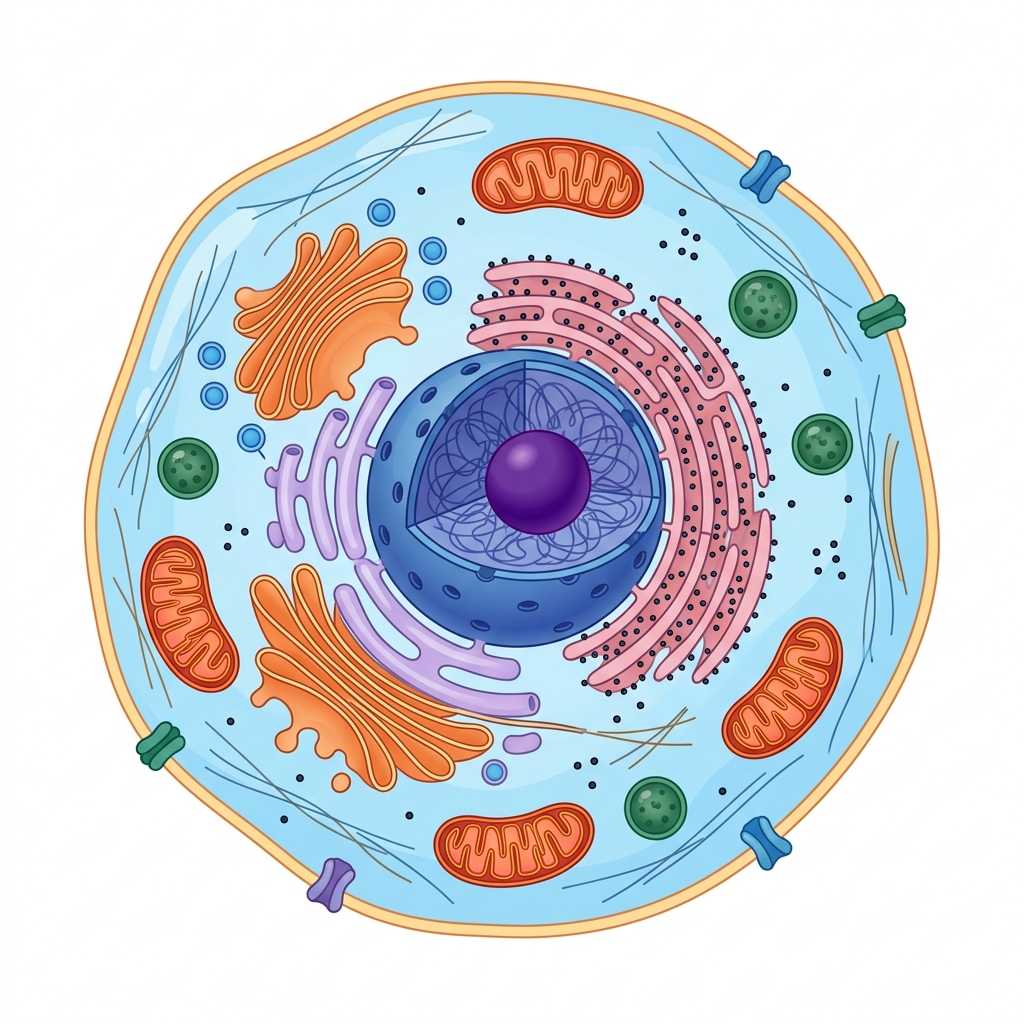
Cell Classification, Boundaries & Transport
कोशिकाओं का वर्गीकरण, आवरण और परिवहन
Prokaryotic Cell ➜ Single Circular DNA (No Histones) ➜ 70S Ribosomes (50S + 30S)
Eukaryotic Cell  ➜ Linear DNA (+ Histones)          ➜ 80S Ribosomes (60S + 40S)
प्रोकैरियोटिक कोशिका ➜ न्यूक्लियॉइड (केंद्रक झिल्ली रहित) ➜ 70S राइबोसोम (50S + 30S)
यूकैरियोटिक कोशिका  ➜ स्पष्ट केंद्रक (दोहरी झिल्ली)      ➜ 80S राइबोसोम (60S + 40S)
- Prokaryotic Cells (1–5 µm): No nuclear envelope; DNA lies naked in the Nucleoid. No membrane-bound organelles. 70S ribosomes (50S+30S). Flagellum = flagellin protein, with Basal body, Hook, Filament. E.g. Bacteria, Cyanobacteria, Mycoplasma.
- Eukaryotic Cells (10–100 µm): True nucleus with double membrane + pores. Membrane-bound organelles present. 80S ribosomes (60S+40S) in cytoplasm; 70S inside mitochondria/chloroplasts. E.g. Plants, Animals, Fungi, Protists.
- प्रोकैरियोटिक कोशिकाएं (1–5 µm): केंद्रक झिल्ली अनुपस्थित; DNA न्यूक्लियॉइड में नग्न। झिल्ली-युक्त कोशिकांग अनुपस्थित। 70S राइबोसोम (50S+30S)। फ्लैजेलम = फ्लैगेलिन प्रोटीन (बेसल बॉडी, हुक, फिलामेंट)। उदा. जीवाणु, नील-हरित शैवाल, माइकोप्लाज्मा।
- यूकैरियोटिक कोशिकाएं (10–100 µm): दोहरी झिल्ली व छिद्रयुक्त सुस्पष्ट केंद्रक। झिल्ली-युक्त कोशिकांग उपस्थित। कोशिकाद्रव्य में 80S राइबोसोम (60S+40S); माइटोकॉन्ड्रिया/लवक में 70S। उदा. पादप, जंतु, कवक, प्रोटिस्ट।
Cell Outer Boundaries
कोशिका के बाहरी आवरण
| Organism | जीव | Cell Wall Made Of | कोशिका भित्ति संघटन |
|---|---|---|---|
| Plants | पौधे | Cellulose (सेल्युलोज) | |
| Fungi | कवक | Chitin (काइटिन) | |
| Bacteria | जीवाणु | Peptidoglycan / Murein (पेप्टिडोग्लाइकन) | |
| Algae | शैवाल | Cellulose & Pectin (सेल्युलोज व पेक्टिन) | |
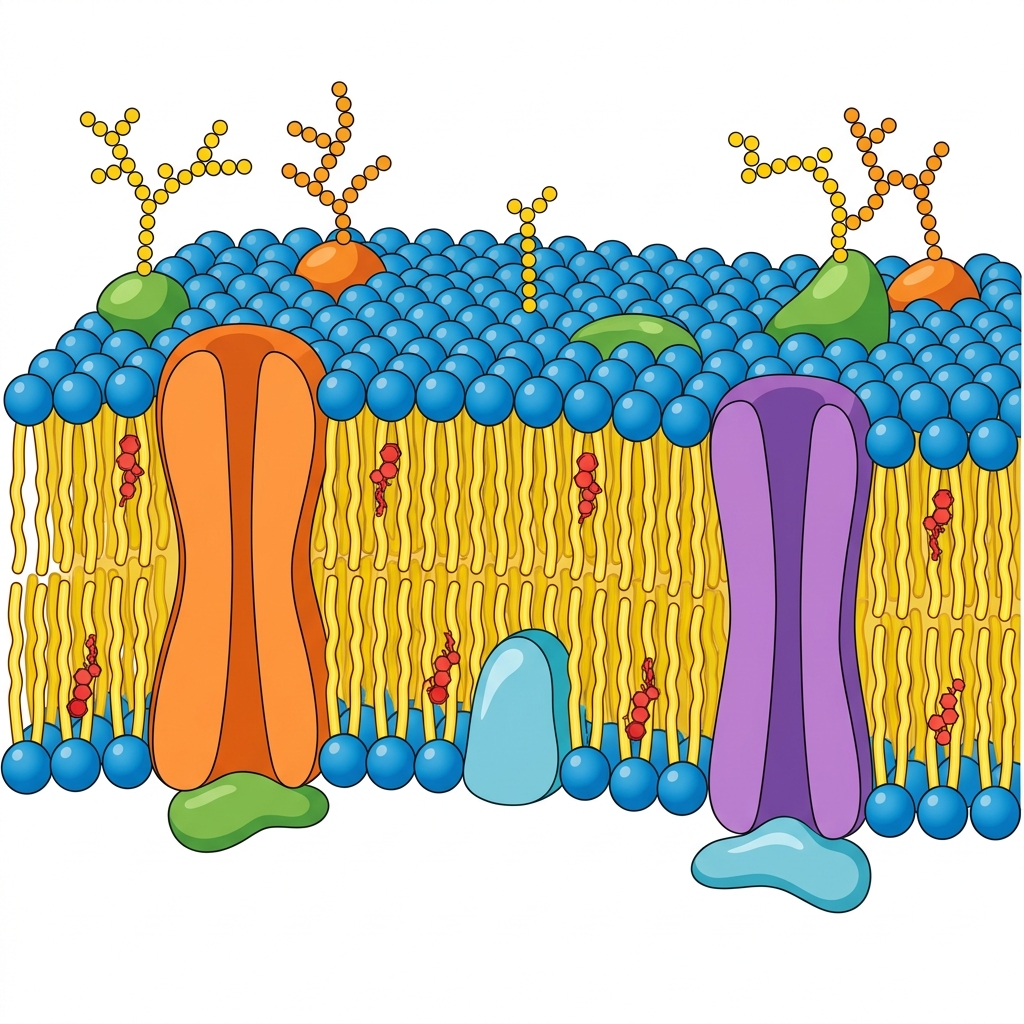
Cell Wall: non-living, rigid, freely permeable; absent in animal cells. Cell Membrane: living, selectively permeable — Fluid Mosaic Model (1972): phospholipid bilayer + floating proteins. Composition: ~52% Proteins, 40% Lipids, 8% Carbohydrates.
कोशिका भित्ति: निर्जीव, कठोर, पूर्णतः पारगम्य; जंतु कोशिकाओं में अनुपस्थित। कोशिका झिल्ली: जीवित, चयनात्मक पारगम्य — फ्लूइड मोज़ेक मॉडल (1972): फॉस्फोलिपिड द्विस्तर + तैरते प्रोटीन। संघटन: ~52% प्रोटीन, 40% लिपिड, 8% कार्बोहाइड्रेट।
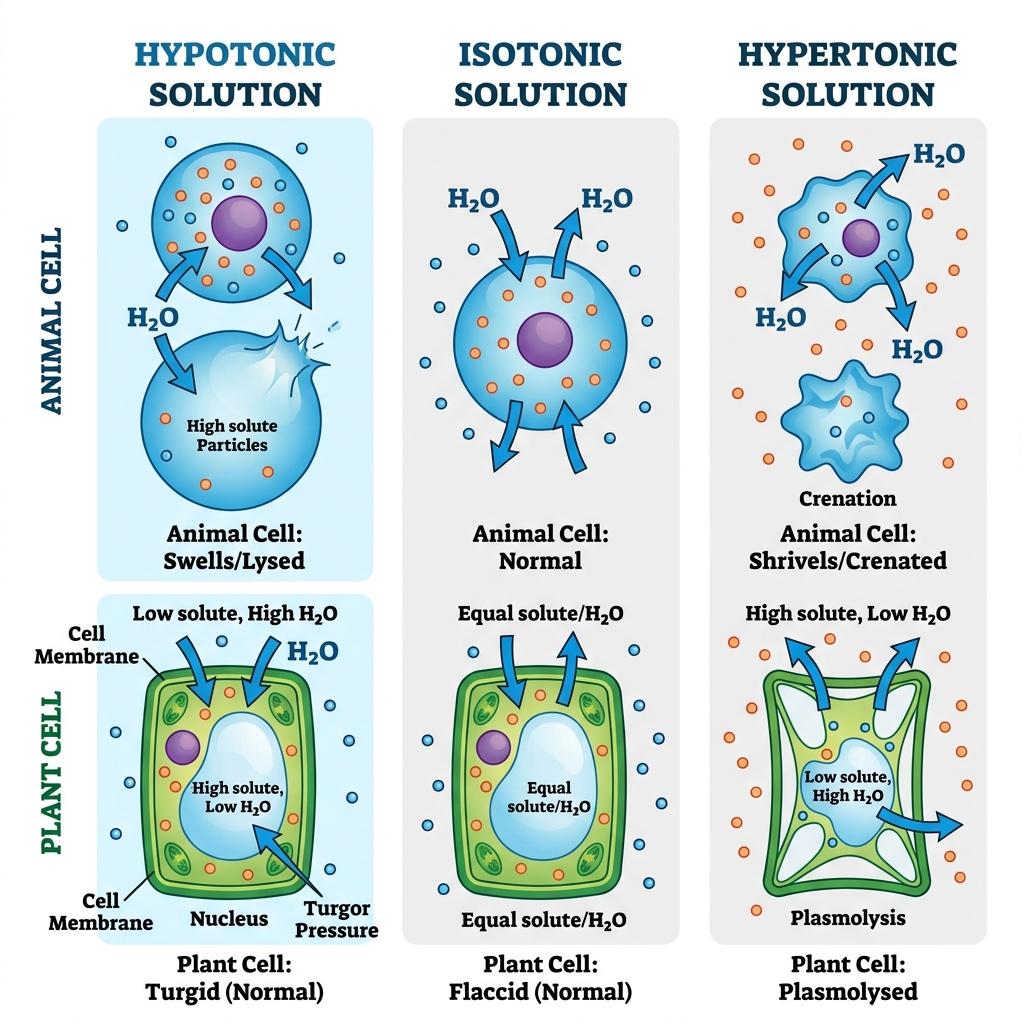
Cellular Transport & Tonicity
कोशिकीय परिवहन और परासरण दाब
- Passive Transport (no ATP): Diffusion (high→low conc.; Gases > Liquids > Solids), Osmosis (water across semi-permeable membrane).
- Active Transport (needs ATP): Endocytosis — Phagocytosis ("cell eating") & Pinocytosis ("cell drinking"); Exocytosis ("cell vomiting").
- निष्क्रिय परिवहन (बिना ATP): विसरण (उच्च→निम्न सांद्रता; गैस>द्रव>ठोस), परासरण (अर्ध-पारगम्य झिल्ली से जल का गमन)।
- सक्रिय परिवहन (ATP आवश्यक): एंडोसाइटोसिस — फैगोसाइटोसिस ("कोशिका भक्षण") व पिनोसाइटोसिस ("कोशिका पान"); एक्सोसाइटोसिस ("कोशिका वमन")।
Hypotonic (solute<outside solvent): cell swells (Turgidity) — animal cells may burst. Hypertonic (solute>outside): cell shrinks (Plasmolysis). Isotonic: no net water movement.
हाइपोटोनिक: जल भीतर जाता है, कोशिका फूलती है — जंतु कोशिका फट सकती है। हाइपरटोनिक: जल बाहर जाता है, कोशिका सिकुड़ती है (Plasmolysis)। आइसोटोनिक: कोई शुद्ध प्रवाह नहीं।
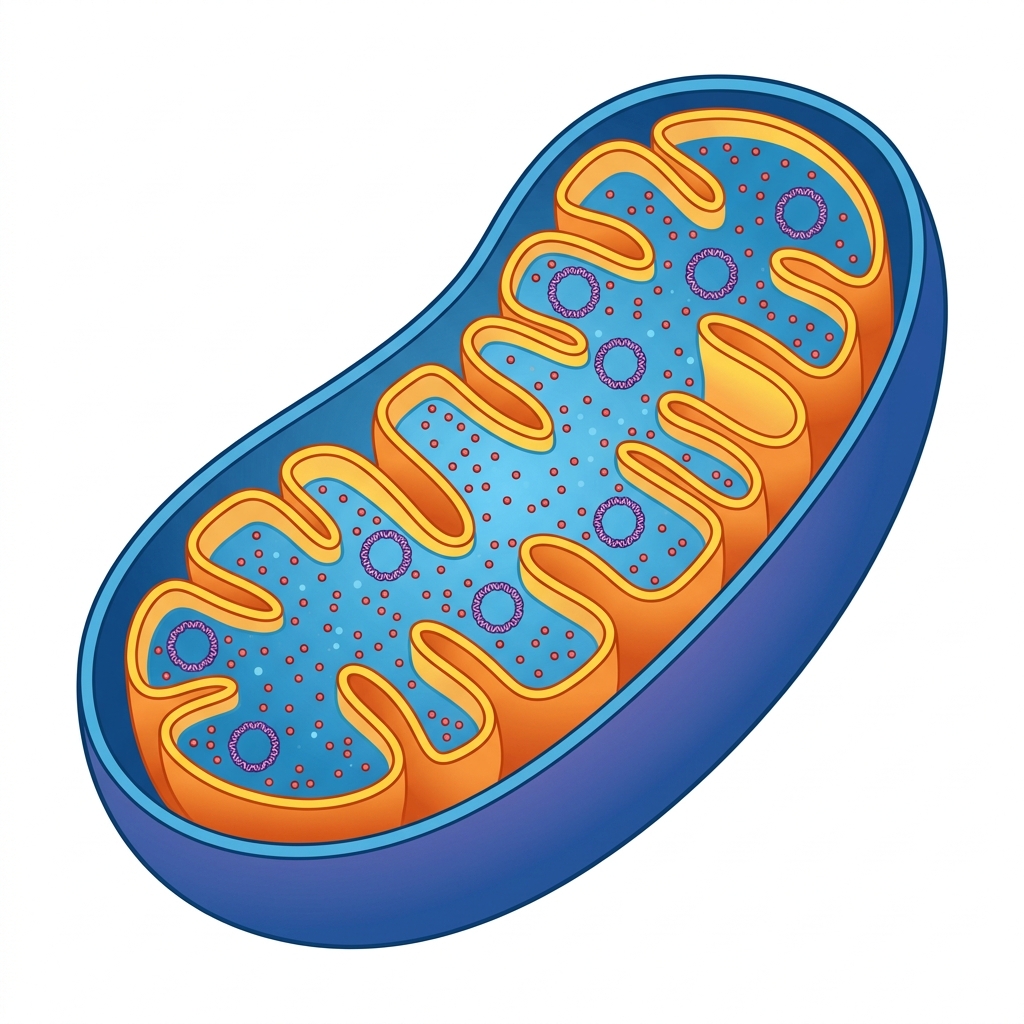
Cell Organelles & Their Specialized Functions
कोशिकांग और उनके विशिष्ट कार्य
Protoplasm = Cytoplasm + Nucleoplasm. 99% made of just four elements: Oxygen (76%), Carbon (10.5%), Hydrogen (10%), Nitrogen (2.5%); water ~80% of volume.
जीवद्रव्य = कोशिकाद्रव्य + केंद्रकद्रव्य। 99% भाग केवल चार तत्वों से: ऑक्सीजन (76%), कार्बन (10.5%), हाइड्रोजन (10%), नाइट्रोजन (2.5%); लगभग 80% जल।
- Mitochondria ("Powerhouse"): double-membraned; inner membrane folds into cristae. Semi-autonomous — own circular DNA + 70S ribosomes. Key orchestrator of apoptosis.
- Lysosomes ("Suicidal Bags"): ~40 hydrolytic enzymes, acidic pH. Digest waste/pathogens; burst → digest own cell. Absent in mammalian RBCs.
- Endoplasmic Reticulum: Rough ER (ribosomes, protein synthesis) vs Smooth ER (lipids/steroids; liver detox via Cytochrome P450).
- Golgi Apparatus ("Post Office"): stacked cisternae; Cis face (convex, receiving) & Trans face (concave, shipping). Called Dictyosomes in plants.
- Ribosomes ("Protein Factory"): non-membranous, translate mRNA→polypeptides.
- Vacuoles: membrane = Tonoplast. Plants: one large permanent central vacuole (50–90% volume). Animals: multiple small temporary vacuoles.
- Centrosome & Centrioles: only in animal cells; 9+0 triplet microtubules; organizes spindle fibers.
- Peroxisomes: contain Catalase; beta-oxidation of fatty acids; neutralize H₂O₂.
- Plastids (plants only): Chloroplasts ("Kitchen" — chlorophyll has central Mg²⁺; Grana = light reactions, Stroma = dark reactions), Chromoplasts (Lycopene = red tomato, Capsanthin = red chilli, Xanthophyll = yellow, Anthocyanin = blue/purple), Leucoplasts (Amyloplasts–starch, Elaioplasts–lipids, Aleuroplasts–protein).
- माइटोकॉन्ड्रिया ("ऊर्जा गृह"): दोहरी झिल्ली; आंतरिक झिल्ली क्रिस्टी में मुड़ी। अर्ध-स्वायत्त — स्वयं का गोलाकार DNA व 70S राइबोसोम। अपोप्टोसिस का नियमन।
- लाइसोसोम ("आत्मघाती थैली"): ~40 प्रकार के अम्लीय एंजाइम। कचरा/जीवाणु पचाते हैं; क्षतिग्रस्त होने पर स्वयं की कोशिका पचाते हैं। RBC में अनुपस्थित।
- अंतःप्रद्रव्यी जालिका: खुरदरी ER (राइबोसोम, प्रोटीन संश्लेषण) बनाम चिकनी ER (लिपिड/स्टेरॉयड; यकृत में साइटोक्रोम P450 द्वारा विषहरण)।
- गॉल्जीकाय ("पोस्ट ऑफिस"): चपटी सिस्टर्नी का समूह; सिस्-फेस (उत्तल, ग्राही) व ट्रांस-फेस (अवतल, प्रेषक)। पौधों में डिक्टियोसोम।
- राइबोसोम ("प्रोटीन फैक्ट्री"): झिल्ली-रहित, mRNA का अनुवाद करते हैं।
- रिक्तिका: झिल्ली = टोनोप्लास्ट। पौधे: एक बड़ी स्थायी केंद्रीय रिक्तिका (50–90% आयतन)। जंतु: कई छोटी अस्थायी रिक्तिकाएं।
- तारककाय व सेंट्रीओल: केवल जंतु कोशिकाओं में; 9+0 ट्रिप्लेट सूक्ष्मनलिकाएं; स्पिंडल फाइबर बनाता है।
- परऑक्सिसोम: कैटालेज एंजाइम; वसा अम्लों का बीटा-ऑक्सीकरण; H₂O₂ को निष्क्रिय करता है।
- लवक (केवल पादप): क्लोरोप्लास्ट ("रसोई" — क्लोरोफिल में Mg²⁺ केंद्र; ग्रेना = प्रकाश अभिक्रिया, स्ट्रोमा = अप्रकाशिक अभिक्रिया), क्रोमोप्लास्ट (लाइकोपीन=लाल टमाटर, कैप्सांथिन=लाल मिर्च, जैंथोफिल=पीला, एन्थोसायनिन=नीला/बैंगनी), ल्यूकोप्लास्ट (एमाइलोप्लास्ट–स्टार्च, एलायोप्लास्ट–लिपिड, एल्यूरोप्लास्ट–प्रोटीन)।
Genetics, DNA Replication & Cell Division
आनुवंशिकी, DNA द्विगुणन और कोशिका विभाजन
- DNA: double-stranded antiparallel helix. Bases: Adenine=Thymine (2 H-bonds), Guanine≡Cytosine (3 H-bonds).
- RNA: single-stranded, Ribose sugar, Uracil instead of Thymine. mRNA (blueprint), tRNA (amino acid adapter), rRNA (ribosome core).
- DNA: दोहरी शृंखला वाली द्विकुंडलित संरचना। क्षार: एडेनिन=थाइमिन (2 H-बंध), ग्वानिन≡साइटोसिन (3 H-बंध)।
- RNA: एकल शृंखला, राइबोज शर्करा, थाइमिन की जगह यूरैसिल। mRNA (ब्लूप्रिंट), tRNA (अमीनो अम्ल वाहक), rRNA (राइबोसोम कोर)।
Chromosome Number Rankings
गुणसूत्रों की संख्या (क्रम)
| Organism | जीव | Pairs | Total |
|---|---|---|---|
| Pigeon | कबूतर | 40 | 80 |
| Dog | कुत्ता | 39 | 78 |
| Horse | घोड़ा | 32 | 64 |
| Chimpanzee | चिंपैंजी | 24 | 48 |
| Human | मानव | 23 | 46 |
| Wheat | गेहूं | 21 | 42 |
| Cat | बिल्ली | 19 | 38 |
| Frog | मेंढक | 13 | 26 |
| Tomato | टमाटर | 12 | 24 |
| Onion | प्याज | 8 | 16 |
| Pea | मटर | 7 | 14 |
| Ascaris | एस्केरिस | 1 | 2 |
Human somatic cells: 46 chromosomes (23 pairs) — 22 autosome pairs + 1 allosome pair (XX female, XY male).
मानव कायिक कोशिकाएं: 46 गुणसूत्र (23 जोड़े) — 22 जोड़े ऑटोसोम + 1 जोड़ा एलोसोम (XX महिला, XY पुरुष)।
DNA Replication Enzymes
DNA द्विगुणन के एंजाइम
Helicase (Unzips) ➜ DNA Primase (RNA Primer) ➜ DNA Polymerase (Builds 5'➜3') ➜ DNA Ligase (Glues Fragments)
हेलीकेस (शृंखला खोलना) ➜ DNA प्राइमेस (प्राइमर निर्माण) ➜ DNA पॉलीमरेज़ (निर्माण) ➜ DNA लाइगेस (खंडों को जोड़ना)
Replication is semi-conservative. Helicase unwinds; Primase lays RNA primer; Polymerase builds 5'→3'; Ligase joins Okazaki fragments; Topoisomerase prevents supercoiling.
द्विगुणन अर्ध-संरक्षी होता है। हेलीकेस खोलता है; प्राइमेस प्राइमर बनाता है; पॉलीमरेज़ नई शृंखला बनाता है; लाइगेस खंड जोड़ता है; टोपोआइसोमेरेज़ कुंडलन रोकता है।
Cell Cycle & Division
कोशिका चक्र और विभाजन
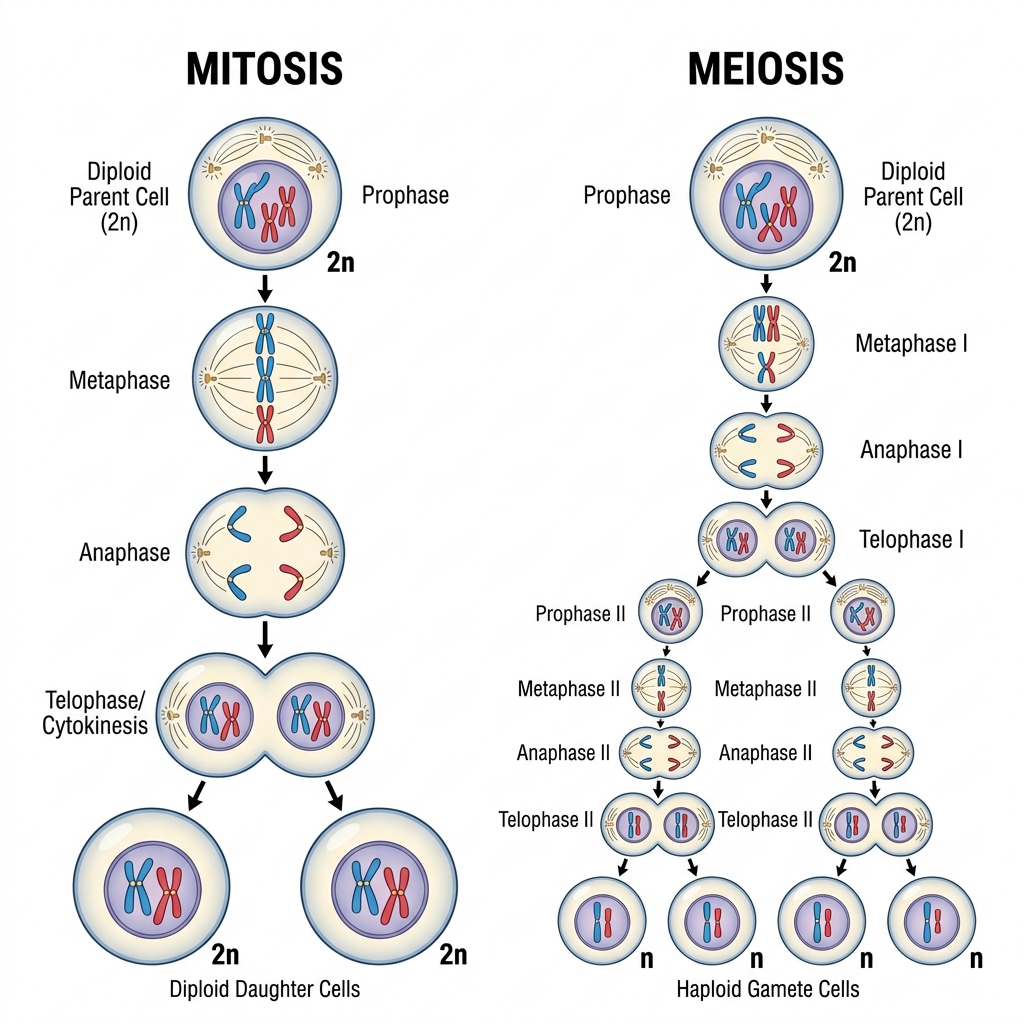
Interphase (~95% of cycle): G1 (growth, RNA/protein synthesis) → S (DNA replicates, content doubles, chromosome no. unchanged) → G2 (final checks) → M-phase (division). G0: quiescent, non-dividing (e.g. neurons).
इंटरफेज (~95% समय): G1 (वृद्धि, RNA/प्रोटीन संश्लेषण) → S (DNA द्विगुणन, गुणसूत्र संख्या अपरिवर्तित) → G2 (अंतिम जांच) → M-फेज (विभाजन)। G0: शांत, अविभाजित अवस्था (जैसे न्यूरॉन)।
| Mitosis | समसूत्री | Meiosis | अर्धसूत्री |
|---|---|---|---|
| Somatic cells; 1 division → 2 identical diploid (2n) cells; growth & repair | कायिक कोशिकाएं; 1 विभाजन → 2 समान द्विगुणित कोशिकाएं; वृद्धि व मरम्मत | ||
| Germ cells; 2 divisions → 4 unique haploid (n) gametes; crossing over in Prophase I (Pachytene) | जनन कोशिकाएं; 2 विभाजन → 4 भिन्न अगुणित युग्मक; Prophase I (Pachytene) में क्रॉसिंग ओवर | ||
Mitotic malfunction → cancerous tumors. Meiotic non-disjunction → Down's Syndrome (Trisomy 21), Klinefelter's (47,XXY), Turner's (45,XO).
समसूत्री खराबी → कैंसर/ट्यूमर। अर्धसूत्री Non-disjunction → डाउन सिंड्रोम (Trisomy 21), क्लिनफेल्टर (47,XXY), टर्नर (45,XO)।
Quick Revision Table
क्विक रिवीजन टेबल
| Topic | विषय | Key Fact | मुख्य तथ्य |
|---|---|---|---|
| Robert Hooke | रॉबर्ट हुक | Father of Cytology; coined "cell" (1665) | कोशिका विज्ञान के जनक; 'Cell' शब्द दिया (1665) |
| Virus | वायरस | Theory exception; no protoplasm | सिद्धांत का अपवाद; जीवद्रव्य अनुपस्थित |
| Protoplasm | जीवद्रव्य | 76% Oxygen; coined by Purkinje (1839) | 76% ऑक्सीजन; पुरकिन्जे (1839) द्वारा नामकरण |
| Mitochondria | माइटोकॉन्ड्रिया | Krebs Cycle site; circular DNA; double membrane | क्रेब्स चक्र स्थल; स्वयं का DNA; दोहरी झिल्ली |
| Smooth ER | चिकनी ER | Lipid synthesis; liver detox via Cytochrome P450 | लिपिड संश्लेषण; यकृत विषहरण (P450) |
| Golgi Apparatus | गॉल्जीकाय | Cis face receives, Trans face ships | Cis-face ग्राही, Trans-face प्रेषक |
| Lysosomes | लाइसोसोम | "Suicidal bags"; absent in RBCs | "आत्मघाती थैली"; RBC में अनुपस्थित |
| Magnesium (Mg²⁺) | मैग्नीशियम | Central ion in chlorophyll | क्लोरोफिल का केंद्रीय आयन |
| S Phase | S फेज | DNA replicates & doubles | DNA का द्विगुणन होता है |
| Pachytene | पैकीटीन | Crossing over occurs here | क्रॉसिंग ओवर यहीं होता है |
| Chitin | काइटिन | Fungal cell wall material | कवक कोशिका भित्ति संघटक |
| Ascaris | एस्केरिस | Fewest chromosomes (1 pair) | न्यूनतम गुणसूत्र (1 जोड़ा) |
Rapid Fire Practice Check
रैपिड फायर अभ्यास प्रश्न
Tap a question to reveal the answer.
उत्तर देखने के लिए प्रश्न पर टैप करें।