Gyaanify
Gyaanify Exam Notes

Mahajanapadas & the Rise of Magadha

Ancient Indian History — from Sixteen Great Territories to the First Empire

Subject: Ancient History Exams: UPSC · SSC CGL · BSSC · State PSCs
Instagram · Gyaanify0907 Telegram · t.me/Gyaanify Bot · t.me/GyaanifyBot

Index

  1. Sources & Causes of Rise of Mahajanapadas
  2. Classification: Monarchies vs Republics (Gana-Sanghas)
  3. The 16 Mahajanapadas: Capitals, Rivers & Key Facts
  4. Rise of Magadha: Dynasties & Key Rulers
  5. Ancient Indian Society, Economy & Administration
  6. Foreign Invasions: Persian & Greek
  7. Quick Revision Table
  8. Multiple Choice Questions (MCQs)
1

Sources & Causes of Rise of Mahajanapadas

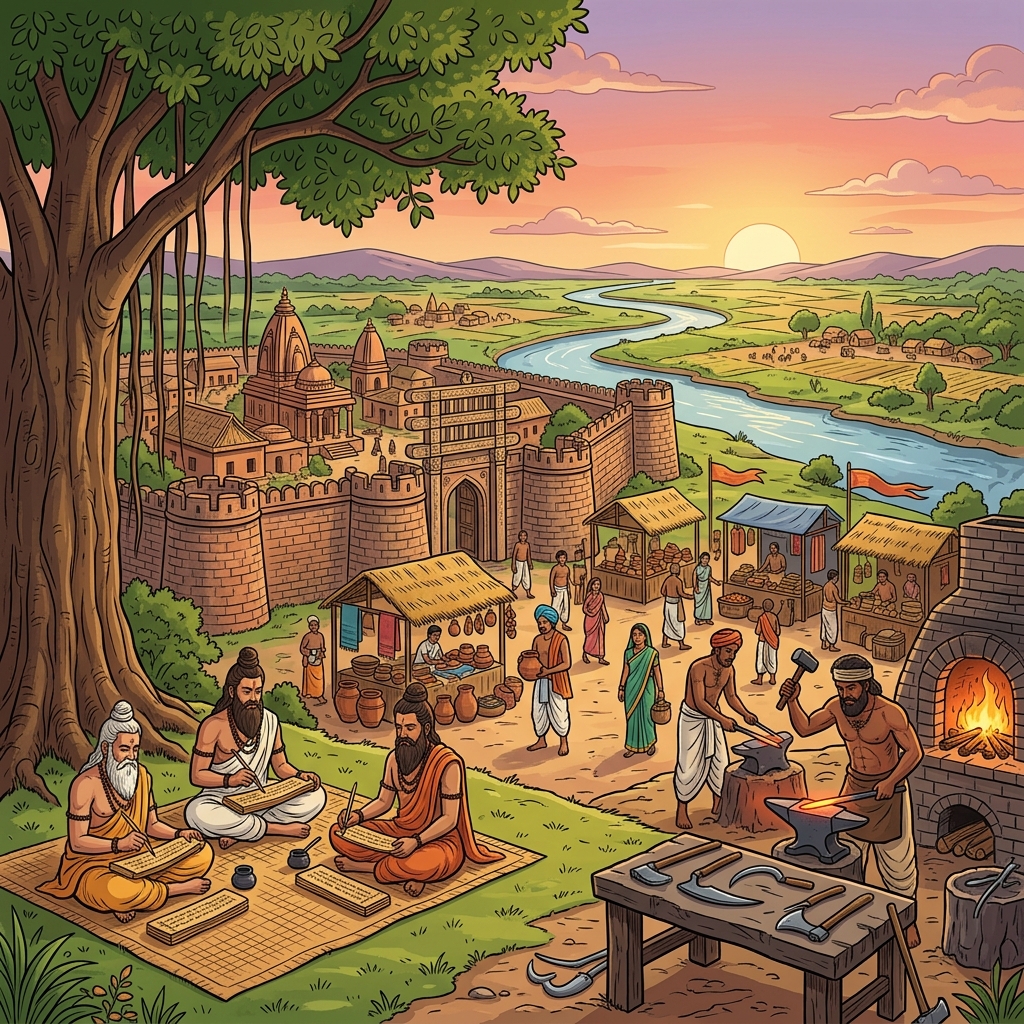
The transition from tribal kinship (Jana) to territorial identity (Janapadas) occurred during the later Vedic Period (1000–600 BCE). By the 6th century BCE, these consolidated into 16 great territorial states known as Sodasha Mahajanapadas.

Causes for the Rise

Literary Sources

Illustration
Image placeholder — to be added manually
2

Classification: Monarchies vs Republics (Gana-Sanghas)

Northern India was divided into two distinct systems of governance:

FeatureMonarchies (Kingdoms)Republics (Gana-Sanghas)
LocationPredominantly in Gangetic plains (North & Central India).Foothills of Himalayas and North-Western India.
Decision MakingHereditary king holds supreme power, assisted by ministers.Collective decision-making by a council (Gana Parishad) via majority vote.
ExamplesMagadha, Kosala, Vatsa, Avanti, Kashi, Panchala, Kuru, Surasena, Matsya, Anga.Vajji (eight clans), Malla, Kuru, Kamboja.
ImportantThe republics (Gana-Sanghas) were oligarchies where power was shared among a ruling clan of Kshatriyas. Vajji was a confederacy of eight clans, including the Jnatrikas, Videhas, and Lichchhavis.
ExceptionsWhile Kuru and Kamboja are listed as republics in some sources (like Kautilya's Arthashastra and Jain texts), they are treated as monarchies in standard Buddhist texts.
3

The 16 Mahajanapadas: Capitals, Rivers & Key Exam Facts

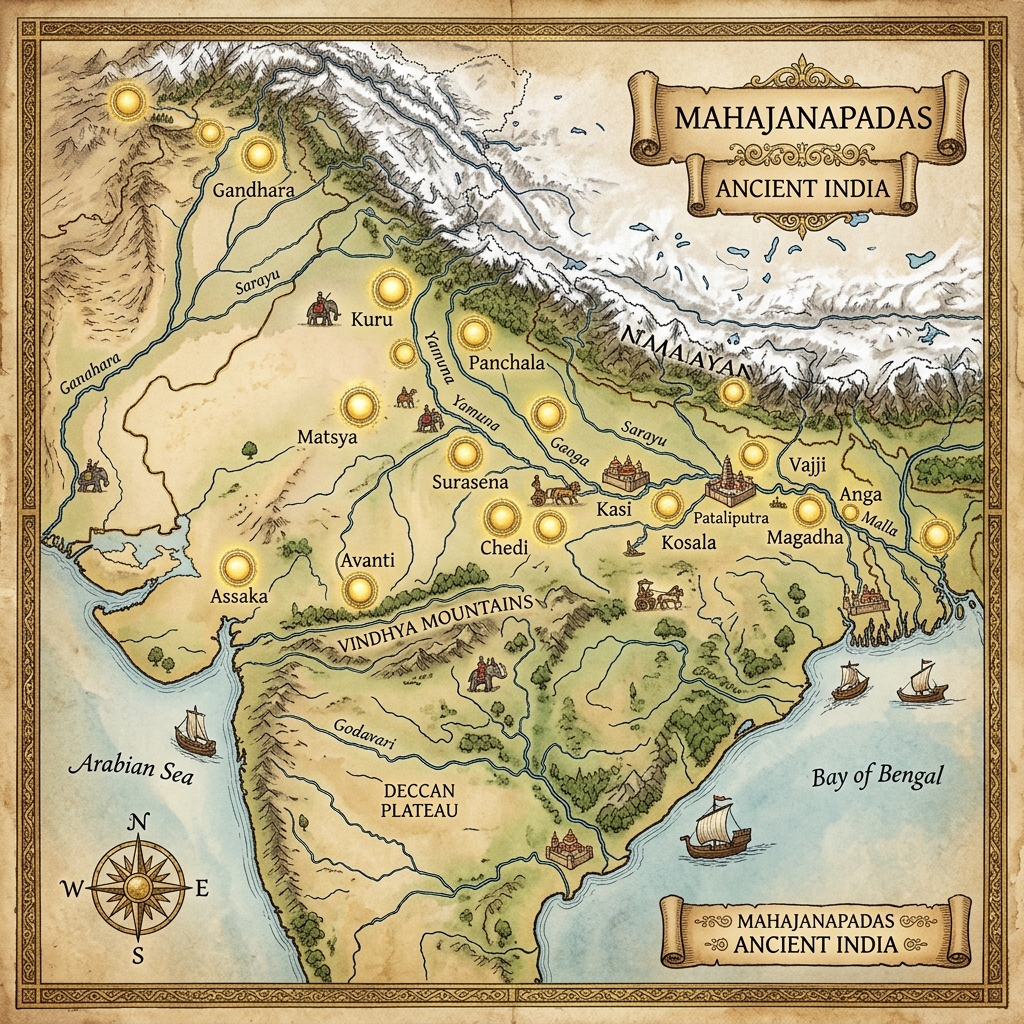
The 16 Mahajanapadas stretched from North-Western Pakistan to East Bihar, and from the Himalayas to the Godavari River.

MahajanapadaCapitalRiverKey Facts
AngaChampaGangaMajor trade and port city, noted for commerce. Annexed to Magadha by Bimbisara. Located in modern Bhagalpur and Munger (Bihar).
MagadhaRajgriha (Girivraja) / PataliputraGanga & SonMost powerful. Surrounded by five hills (Rajgir). Pataliputra was a Jaladurga (water-fort). Abundant iron deposits nearby.
KasiVaranasiGomti (at Asi & Varuna confluence)Major cloth/cotton manufacturing centre and market for horses. Near modern Varanasi.
KosalaSravasti / SaketaSarayuBirthplace of Lord Rama. Ruled by King Prasenajit. Buddha called himself a Kosalan. Located in Eastern UP.
VajjiVaishaliGandakConfederacy of 8 clans (Lichchhavis, Videha, Jnatrika). Republican governance. Modern Muzaffarpur (Bihar).
MallaKusinara / PavaSarayu / GandakRepublican state. Site of Buddha's Mahaparinirvana near Kusinara. Located in modern Gorakhpur (UP).
ChediSuktimati (Sothivati)Ken & BetwaRuled by Shishupala (cousin of Lord Krishna). Located in Bundelkhand (UP).
VatsaKaushambiGanga / YamunaRuled by King Udayana, known for military strength and love for music. Near modern Allahabad (UP).
KuruIndraprasthaYamunaSite of the Kurukshetra war. Famous for political stability and administrative efficiency. Meerut-Delhi region.
PanchalaAhicchatra (North) / Kampilya (South)GangaFamous centre of Vedic learning and Upanishadic philosophy. Sages Yajnavalkya and Kapila associated here. Western UP.
SurasenaMathuraYamunaAssociated with Lord Krishna. Located at the junction of Uttarpatha and Dakshinapatha trade routes. Mathura (UP).
MatsyaViratnagarYamunaRuled by King Virata. Hiding place used by Pandavas during exile. Near Jaipur (Rajasthan).
AvantiUjjain (North) / Mahishmati (South)Shipra & NarmadaRuled by King Chand Pradyota. High-grade iron ore mines enabled advanced weaponry. Malwa region.
GandharaTaxilaIndusFamous for Taxila University (world's oldest). Persian and Greek cultural influences. Modern Peshawar (Pakistan).
KambojaPooncha / Rajpura (Hataka)Kabul & KurramKnown for superior horse breeds and warrior clans. Regarded as "uncultured" by orthodox Brahmanical texts. Near Gandhar.
AsmakaPratisthan (Paithan) / PotaliGodavariOnly Mahajanapada located in Southern India (modern Maharashtra).
TipLocation Hack: Out of the 16 Mahajanapadas, 8 are located in modern Uttar Pradesh, 3 in Bihar, 1 in Rajasthan, 1 in Madhya Pradesh, 1 in Maharashtra, and 2 in the North-West (Pakistan/Afghanistan frontier).
Illustration
Image placeholder — to be added manually
4

Rise of Magadha: Dynasties & Key Rulers

Factors for Magadha's Supremacy

544–412 BCE
Haryanka Dynasty
412–345 BCE
Shishunaga Dynasty
345–321 BCE
Nanda Dynasty

A. Haryanka Dynasty (544–412 BCE)

Bimbisara (544–492 BCE)

  • Firsts: Established the first standing army in India.
  • Titles: Called Seniya or Shrenika in Jain literature.
  • Matrimonial Alliances: Married three princesses — Kosala Devi (sister of Kosala ruler Prasenjit, brought Kashi as dowry), Chellana (Lichchhavi princess), and Khema (Madra clan of Punjab).
  • Military Expansion: Defeated and annexed Anga.
  • Diplomacy: Sent royal physician Jivaka to Ujjain to treat King Chand Pradyota of Avanti for jaundice.
  • Religious Contemporaries: Personal friend and contemporary of both Gautama Buddha and Mahavira.

Ajatshatru (492–460 BCE)

  • Ascension: Imprisoned and killed his father Bimbisara.
  • Military Conquests: Defeated Kosala and the Vajji confederacy after a grueling 16-year war.
  • Espionage: Dispatched minister Vassakar to infiltrate and divide the Vajji confederacy.
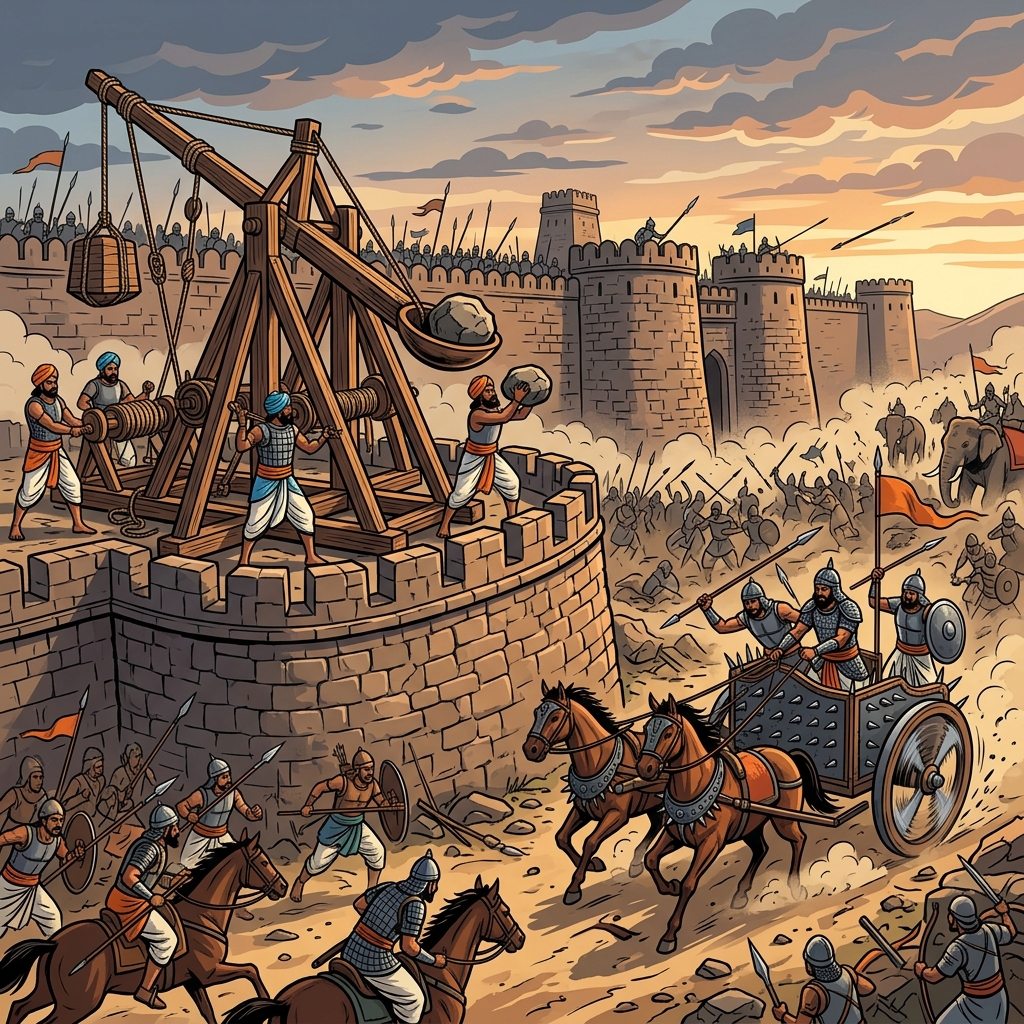
  • Military Innovations: Introduced Mahashilakantaka (stone-throwing catapult) and Rathamusala (chariot with rotating blades).
  • Fortification: Built a fort to defend against Lichchhavi attacks and established a watchpost at Patali (Patali-grama).
  • Religious Patronage: Convened the First Buddhist Council at Saptaparni Cave, Rajagriha, immediately after Buddha's death.

Udayin (460–444 BCE)

  • Capital Shift: Shifted the imperial capital from Rajgriha to Pataliputra (at the confluence of Ganga and Son rivers).
  • Religion: Devout follower of Jainism.
  • End of Dynasty: The last Haryanka ruler was Nagadasaka, who was assassinated by his minister Shishunaga.
Illustration
Image placeholder — to be added manually
B. Shishunaga Dynasty (412–345 BCE)

Shishunaga (412–394 BCE)

  • Conquests: Annexed Avanti (Malwa) into Magadha, ending a century-long rivalry.
  • Capital Shift: Temporarily shifted the capital to Vaishali.

Kalasoka (Kakavarna) (394–366 BCE)

  • Capital Shift: Permanently shifted the capital back to Pataliputra.
  • Religious Patronage: Convened the Second Buddhist Council at Vaishali.
  • End of Dynasty: The last ruler was Nandivardhana (killed by Mahapadma Nanda).

C. Nanda Dynasty (345–321 BCE)

Mahapadma Nanda (345–329 BCE)

  • Firsts: Regarded as the "First Empire Builder of India". According to Puranas, he was of non-Kshatriya (Shudra) origin.
  • Titles: Ekarat (Sole Sovereign) and Sarvakshatrantaka (Uprooter of all Kshatriyas).
  • Conquests: Conquered Kalinga (subsequently mentioned in the Hathigumpha inscription of Kharavela).

Dhana Nanda (329–321 BCE)

  • Wealth: Possessed fabulous wealth and an enormous army (200,000 infantry, 20,000 cavalry, 3,000 chariots, 6,000 war elephants).
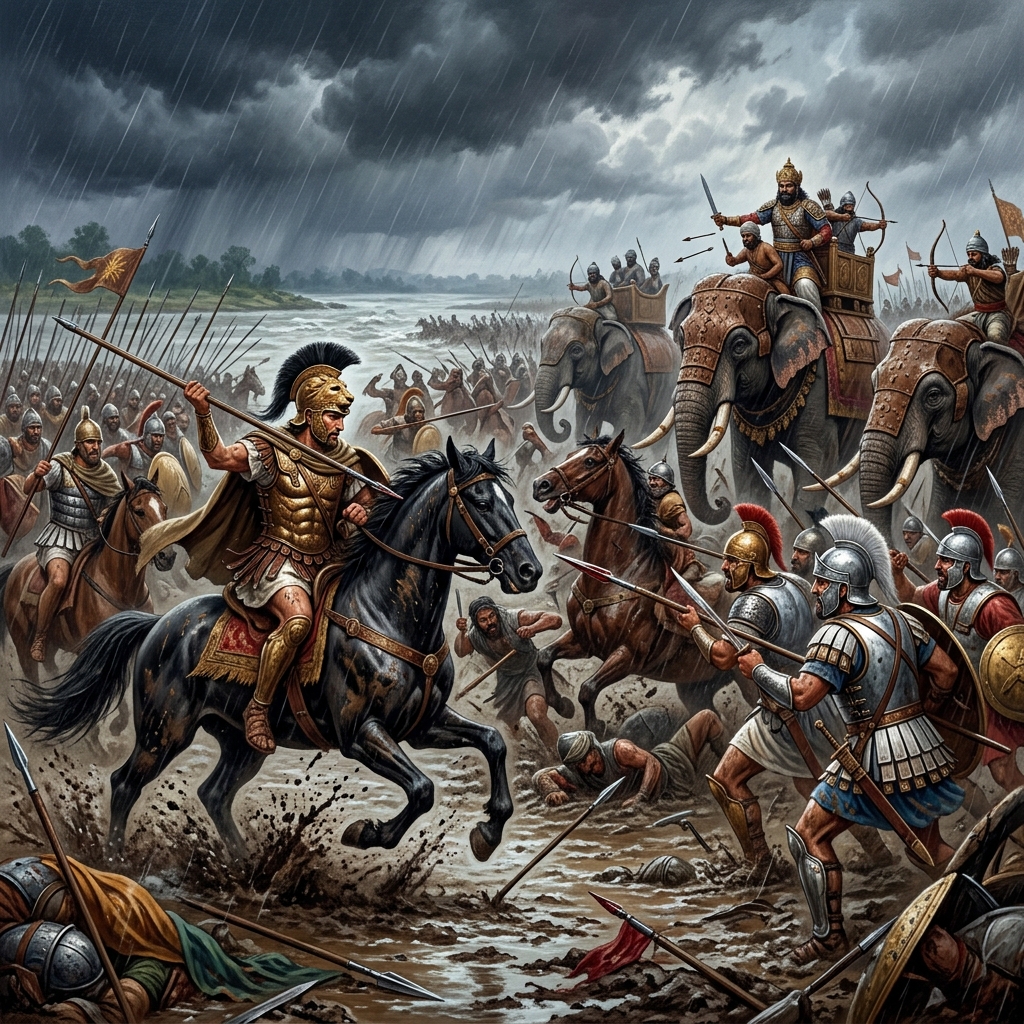
  • Alexander's Invasion: Alexander's army invaded India during his reign (326 BCE) but refused to cross the Beas River, fearing Nanda's military power.
  • End of Dynasty: Overthrown and executed by Chandragupta Maurya assisted by Chanakya (Kautilya), leading to the rise of the Mauryan Empire.
5

Ancient Indian Society, Economy & Administration

Key Administrative Terms

Economy, Coins & Trade

6

Foreign Invasions: Persian (Achaemenid) & Greek (Macedonian)

North-West India (modern Punjab, Gandhara, Kamboja) was highly fragmented and politically unstable during the 6th century BCE, making it vulnerable to foreign invasions.

516 BCE
Darius I (Persian)
326 BCE
Alexander (Greek)

A. Persian (Achaemenid) Invasion

Impact: Introduction of the Kharosthi Script (right to left, derived from Aramaic); inspired monolithic Persian-style pillars, later influencing Ashoka's pillars; facilitated Indo-Iranian commerce.

B. Greek (Macedonian) Invasion

Illustration
Image placeholder — to be added manually

Impact: Opened four trade routes (three by land, one by sea) between India and Europe; established Greek settlements like Alexandria and Boukephala; led to the Gandhara School of Art (cultural synthesis of Greek and Indian styles); weakened small border states, paving the way for Chandragupta Maurya to unify Northern India.

7

Quick Revision Table

Topic / RulerMost Critical FactHigh Probability Focus
Oldest GrammarAshtadhyayi by Panini (4th–6th century BCE)Sanskrit Grammar
Southernmost StateAsmaka (Capital: Paithan/Pratisthan) on GodavariOnly Southern Mahajanapada
BimbisaraKnown as Seniya / Shrenika; first to maintain a standing armyMatrimonial diplomacy
AjatshatruUsed Vassakar to split Vajji; used Mahashilakantaka & RathamusalaFirst Buddhist Council
UdayinShifted Magadha's capital to Pataliputra (confluence of Ganga & Son)Jainism follower
KalasokaShifted capital back to Pataliputra; hosted Second Buddhist CouncilVaishali Council
Mahapadma NandaKnown as Ekarat & Sarvakshatrantaka; conquered KalingaFirst non-Kshatriya king
Darius IAnnexed North-West India (516 BCE); made it the 20th SatrapyTribute: 360 gold talents
Battle of HydaspesFought in 326 BCE on the banks of Jhelum between Alexander and Porus19-month stay of Alexander
Socio-EconomyLand tax: 1/6th (Bhaga); Currency: Silver punch-marked & Gold (Nishka)Northern Black Polished Ware
8

Multiple Choice Questions (MCQs)

Tap a question to reveal the answer.

Which Buddhist text provides the comprehensive list of the sixteen Mahajanapadas?
(A) Digha Nikaya
(B) Anguttara Nikaya
(C) Majjhima Nikaya
(D) Mahavamsa
Answer: (B) Anguttara Nikaya
Which of the following is the only Mahajanapada located in Southern India along the Godavari River?
(A) Matsya
(B) Chedi
(C) Asmaka
(D) Avanti
Answer: (C) Asmaka
What was the name of Bimbisara's royal physician who was sent to treat King Chand Pradyota of Avanti?
(A) Charaka
(B) Sushruta
(C) Jivaka
(D) Dhanvantari
Answer: (C) Jivaka
Which Magadhan ruler used the advanced military weapons "Mahashilakantaka" and "Rathamusala" for the first time?
(A) Bimbisara
(B) Ajatshatru
(C) Udayin
(D) Mahapadma Nanda
Answer: (B) Ajatshatru
Who was the last ruler of the Haryanka Dynasty, who was overthrown by his minister Shishunaga?
(A) Kalasoka
(B) Nagadasaka
(C) Nandivardhana
(D) Dhana Nanda
Answer: (B) Nagadasaka
The Second Buddhist Council was organised at Vaishali during the reign of which king?
(A) Ajatshatru
(B) Shishunaga
(C) Kalasoka
(D) Mahapadma Nanda
Answer: (C) Kalasoka
Which Nanda ruler is described in Puranic texts as 'Sarvakshatrantaka' and 'Ekarat'?
(A) Dhana Nanda
(B) Mahapadma Nanda
(C) Nandivardhana
(D) Shishunaga
Answer: (B) Mahapadma Nanda
The Persian ruler Darius I annexed North-West India in 516 BCE. This region became which Satrapy of the Persian Empire?
(A) 15th Satrapy
(B) 18th Satrapy
(C) 20th Satrapy
(D) 22nd Satrapy
Answer: (C) 20th Satrapy
On the banks of which river was the famous Battle of Hydaspes (326 BCE) fought between Alexander and King Porus?
(A) Indus
(B) Jhelum
(C) Chenab
(D) Beas
Answer: (B) Jhelum
Why did Alexander the Great's army refuse to cross the Beas River (Hyphasis)?
(A) Extreme winter conditions
(B) Outbreak of plague in the Greek camp
(C) Fear of the massive army and war elephants of the Nanda Empire
(D) Lack of sea-route communication
Answer: (C) Fear of the massive army and war elephants of the Nanda Empire
The ancient town of Mathura (capital of Surasena) was located at the junction of which two famous trade routes?
(A) Silk Route and Spice Route
(B) Uttarpatha and Dakshinapatha
(C) Pataliputra Route and Taxila Route
(D) Indo-Roman Trade Route
Answer: (B) Uttarpatha and Dakshinapatha
What was the standard rate of land revenue (Bhaga) paid by peasants during the Mahajanapada period?
(A) 1/4th of the produce
(B) 1/5th of the produce
(C) 1/6th of the produce
(D) 1/10th of the produce
Answer: (C) 1/6th of the produce