Ancient History · UPSC / SSC / BSSC / State PSC
Ancient India: Stone Age to Chalcolithic Period
A single-page revision layer, built like a dig site — oldest material at the bottom, most recent on top. Toggle language and theme from the top bar.
01
Basics of Pre-History, Timelines & Archaeology
Historical Classifications & Divisions
- Age of the Earth: approximately 4.5 billion years old.
- Geological Eras: current era is the Quaternary Stage of Life, which began 2.58 million years ago and continues to the present.
Quaternary Stage = Pleistocene (Ice Age) + Holocene (After Ice Age)
= प्लीस्टोसिन (हिमयुग) + होलोसीन (हिमयुग के बाद)
- James Mill's Division: authored 'History of British India' and divided Indian history into three phases.
Hindu → Muslim → British
→ मुस्लिम → ब्रिटिश
- C.J. Thomson's Division: categorised ancient history by the primary material used for tools.
Stone Age → Bronze Age → Iron Age
→ कांस्य युग → लौह युग
Archaeological Divisions
- Pre-History: complete lack of written evidence; reconstructed entirely from excavated material remains (e.g. Stone Age, Copper Age).
- Proto-History: written scripts exist but remain undeciphered, or limited written records with rich archaeological finds (e.g. Bronze Age / Indus Valley Civilisation).
Important
Alexander Cunningham was the First Director-General of the Archaeological Survey of India (ASI), universally known as the "Father of Indian Archaeology."
02
Palaeolithic Age (Old Stone Age)
5,00,000 B.C. — 10,000 B.C.
Key Characteristics & Livelihood
- Developed entirely during the Pleistocene epoch (Ice Age).
- Palaeolithic humans in India belonged to the Negrito race.
- Nomadic hunters and food gatherers, relying on wild fruits and vegetables.
- No knowledge of agriculture, fire, or metal pottery.
- Tools were unpolished, rough stones made of hard 'quartzite' — handaxes, cleavers, choppers, flakes, burins, scrapers.
Exceptions
Palaeolithic sites are spread across nearly all of India, except the alluvial plains of the Indus and Ganga rivers.
A. Lower / Early Palaeolithic (5 Lakh B.C. – 50,000 B.C.)
Soan / Sohan Valley (Punjab)
Chopper-chopping tool culture.Belan Valley (Mirzapur, UP)
Famous for rock shelters.Didwana (Rajasthan)
Important desert site with stratified layers.Hunasagi / Hungsi (Karnataka)
Early stone tool workshop.Pahalgam (Kashmir)
Himalayan site.Patne (Maharashtra)
Ostrich eggshell evidence discovered here — first time in India.B. Middle Palaeolithic (50,000 B.C. – 40,000 B.C.)
Based on "Flake Technology" — striking a stone core to remove sharp flakes.
Attirampakkam (Tamil Nadu)
Notable for fossilised animal footprints.C. Upper Palaeolithic (40,000 B.C. – 10,000 B.C.)
Coincided with the last phase of the Ice Age. First appearance of Homo Sapiens and extensive use of Flint Stone.
Bhimbetka Caves (Madhya Pradesh)
Rock paintings.Inamgaon & Nevasa (Maharashtra)
Upper Palaeolithic deposits.Didwana (Rajasthan)
Continuous stratigraphic record.Rock Art & Human Evolution
- Sohagighat (UP): Archibald Carlleyle (or Campbell) was the first to identify rock paintings in India, here.
- Bhimbetka Caves (Vindhyan Range, MP): discovered in 1957 by V.S. Wakankar, "Father of Indian Rock Art." Contains India's oldest paintings.
- Lakhudiyar Cave Painting (Uttarakhand): near the Suyal River, Almora district.
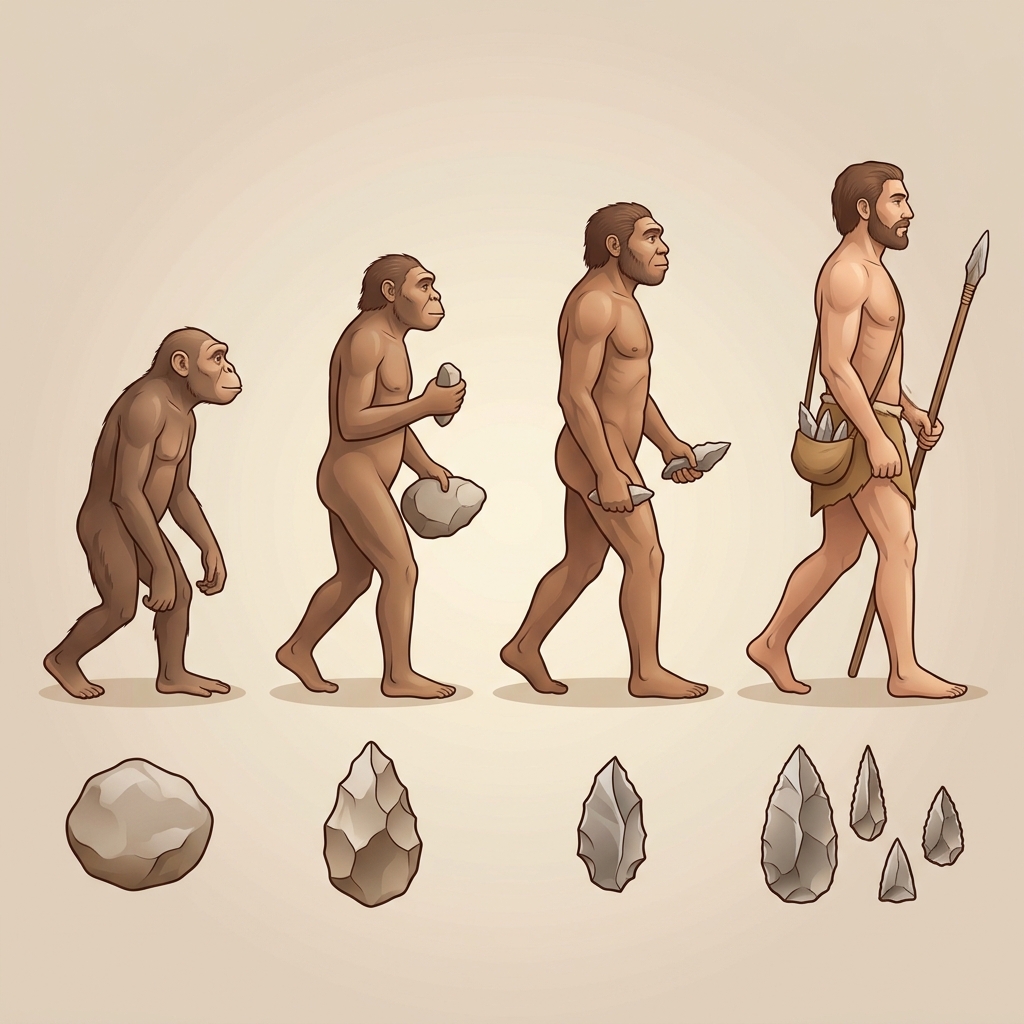
Australopithecus → Homo Habilis → Homo Erectus → Homo Neanderthalensis → Homo Sapiens
→ होमो हैबिलिस → होमो इरेक्टस → होमो निएंडरथलेन्सिस → होमो सेपियन्स
Tip
Mnemonic for the evolution sequence: "Ask Him Every Night Smartly" — Australopithecus → Habilis → Erectus → Neanderthalensis → Sapiens.
03
Mesolithic Age (Middle Stone Age)
10,000 B.C. — 6,000 B.C.
Key Characteristics & Livelihood
- Transition phase between Palaeolithic and Neolithic. Climate turned warmer, flora and fauna increased.
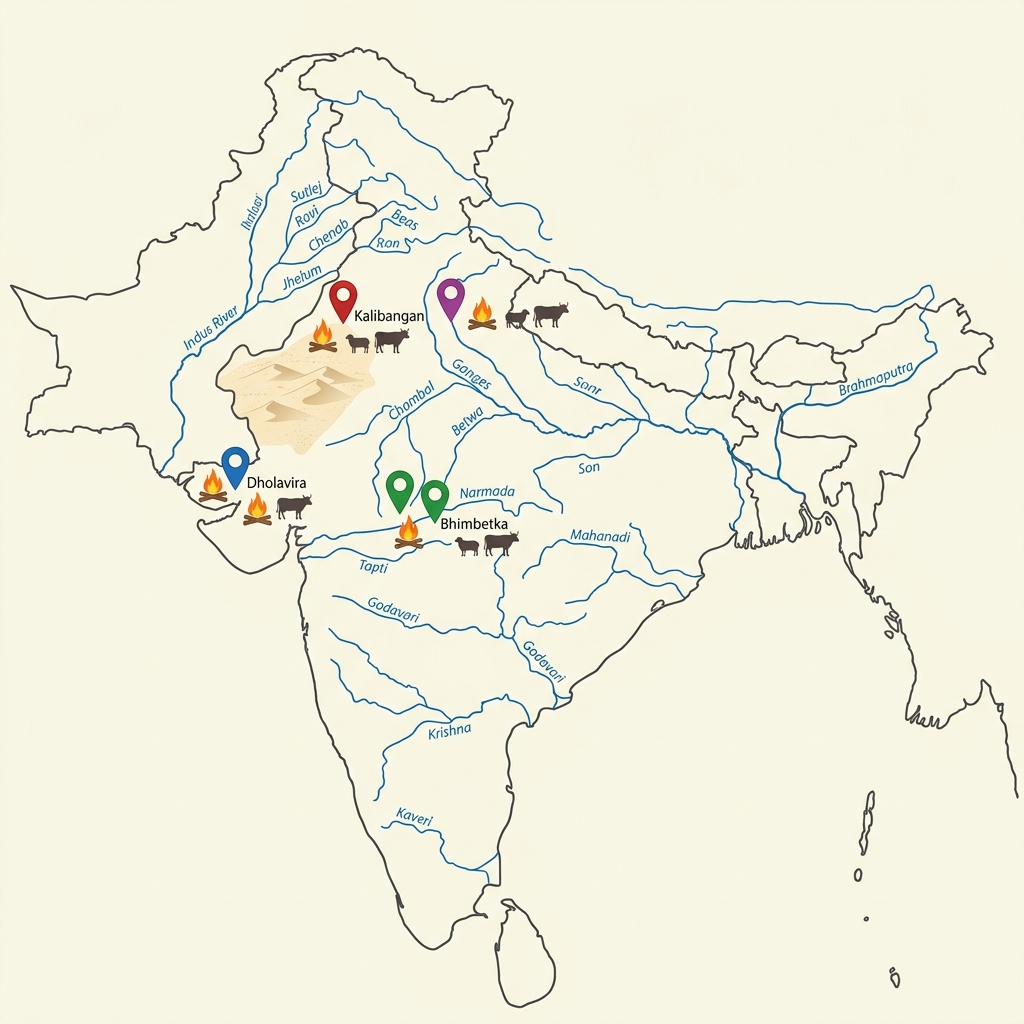
- Primarily hunters and herders — domestication of animals officially began here.
- Tiny sharp stone tools called Microliths: Blade, Core, Point, Triangle, Lunate, Trapeze.
Exceptions
General timeline: 10,000–6,000 B.C. But SSC conventionally uses 12,000–10,000 B.C. for the Mesolithic period.
Key Sites & Discoveries
Bagor & Adamgarh (Rajasthan / Madhya Pradesh)
Earliest excavated evidence of animal domestication in India.Chopani Mando (Belan Valley, UP)
Earliest evidence of pottery use in the world.Langhnaj (Gujarat)
Key microlithic yield site.Sanganakallu (Karnataka)
Important southern Mesolithic site.Tuticorin (Southern Tamil Nadu)
Coastal teri sites.Damdama (UP)
Three human skeletons recovered in a single grave.Sarai Nahar Rai (UP)
Grave with four human skeletons.Mahadaha (UP)
Bone implements and ornaments, along with Sarai Nahar Rai and Damdama.Skeletal discoveries per 'Puratattva Vimarsh' by Dr. Jai Narayan Pandey.
04
Neolithic Age (New Stone Age)
7,000 B.C. — 1,000 B.C. (also 6,000–2,500 B.C. regionally)
Key Characteristics & Livelihood
- The term 'Neolithic' was coined by Sir John Lubbock in 'Pre Historic Times.'
- The beginning of agriculture — humans became food producers instead of food gatherers.
- Settled life in circular or rectangular houses; began owning personal property.
- Highly polished stone tools; developed Cord-impressed pottery to store surplus grain.
- The first cereal used by man was Barley (around 8,000 B.C.).
Critical Neolithic Sites
Mehrgarh (Balochistan, Pakistan)
The oldest Neolithic site in the subcontinent — earliest settled life and cultivation of wheat, barley, cotton.Lahuradeva (Uttar Pradesh)
Earliest evidence of agriculture in the Indian subcontinent (rice, ~9,000–7,000 B.C.).Koldihwa & Mahagara (Belan Valley, UP)
Earliest evidence of rice cultivation (~7,000 B.C.).Burzahom (Kashmir, 16 km west of Srinagar)
Pit dwellings, bone tools, and unique evidence of burying domestic dogs with their masters.Gufkral (Kashmir, 41 km SE of Srinagar)
Name means "cave of potters." Famous for agriculture and animal domestication.Chirand (Bihar)
Abundance of tools made from animal bones.Sanganakallu (Karnataka)
Famous for ash mounds.Daojali Hading (Assam)
Notable for discovery of Jadeite stone.Catal Huyuk (Turkey)
One of the world's first human protocities, contemporary to the late Neolithic.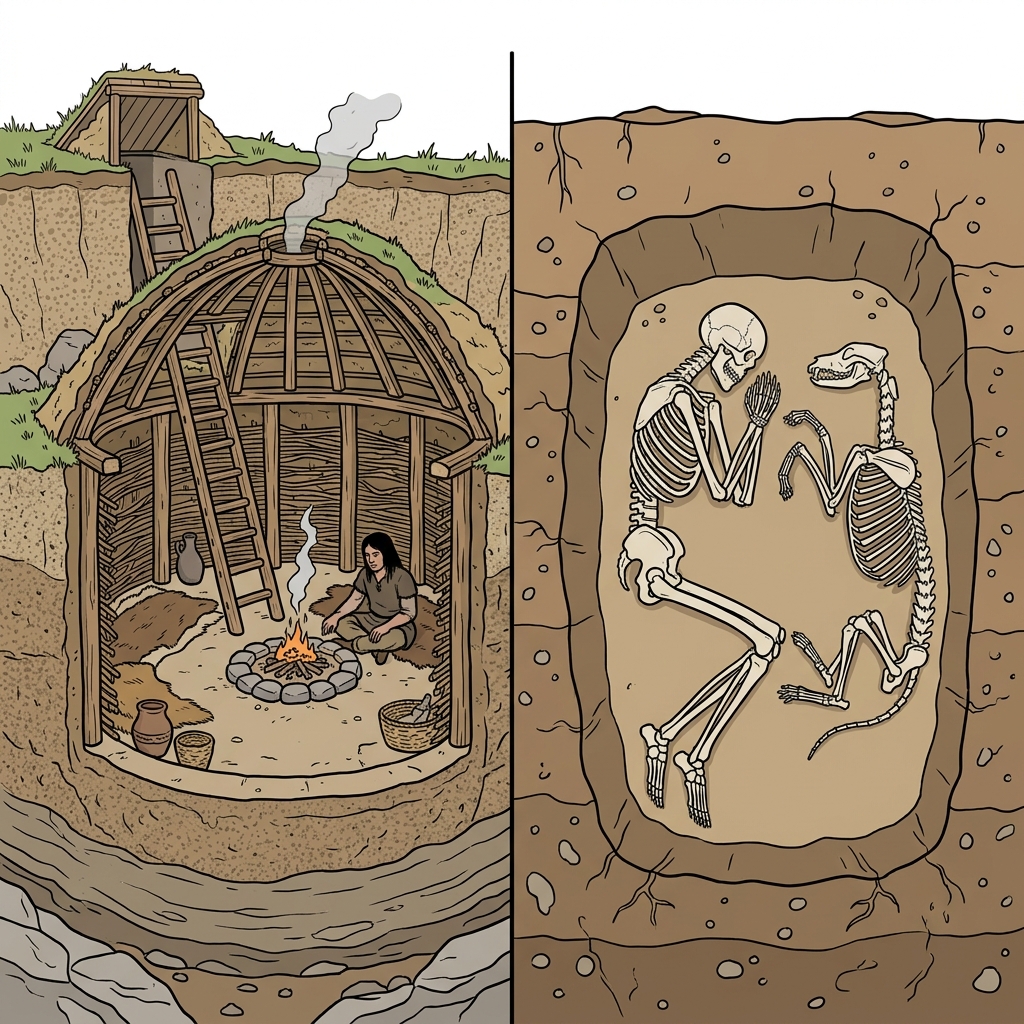
05
Chalcolithic Period (Stone-Copper Phase)
3,500 B.C. — 1,000 B.C.
Key Characteristics & Livelihood
- Copper was the first metal discovered and used by humans.
- People lived in rural communities in thatched houses.
- Worshipped the Mother Goddess and the Bull.
- Practised "Urn" burials — bones collected in pots and buried.
- Black and Red ware was the most popular pottery, alongside Ochre Coloured Pottery (OCP).
Exceptions
Chalcolithic people were NOT acquainted with burnt bricks or domestic horses — they lived exclusively in mud-plastered or thatched houses.
Key Locations & Regional Cultures
- Major copper mines: Khetri Mines (Rajasthan), Malajkhand (Madhya Pradesh).
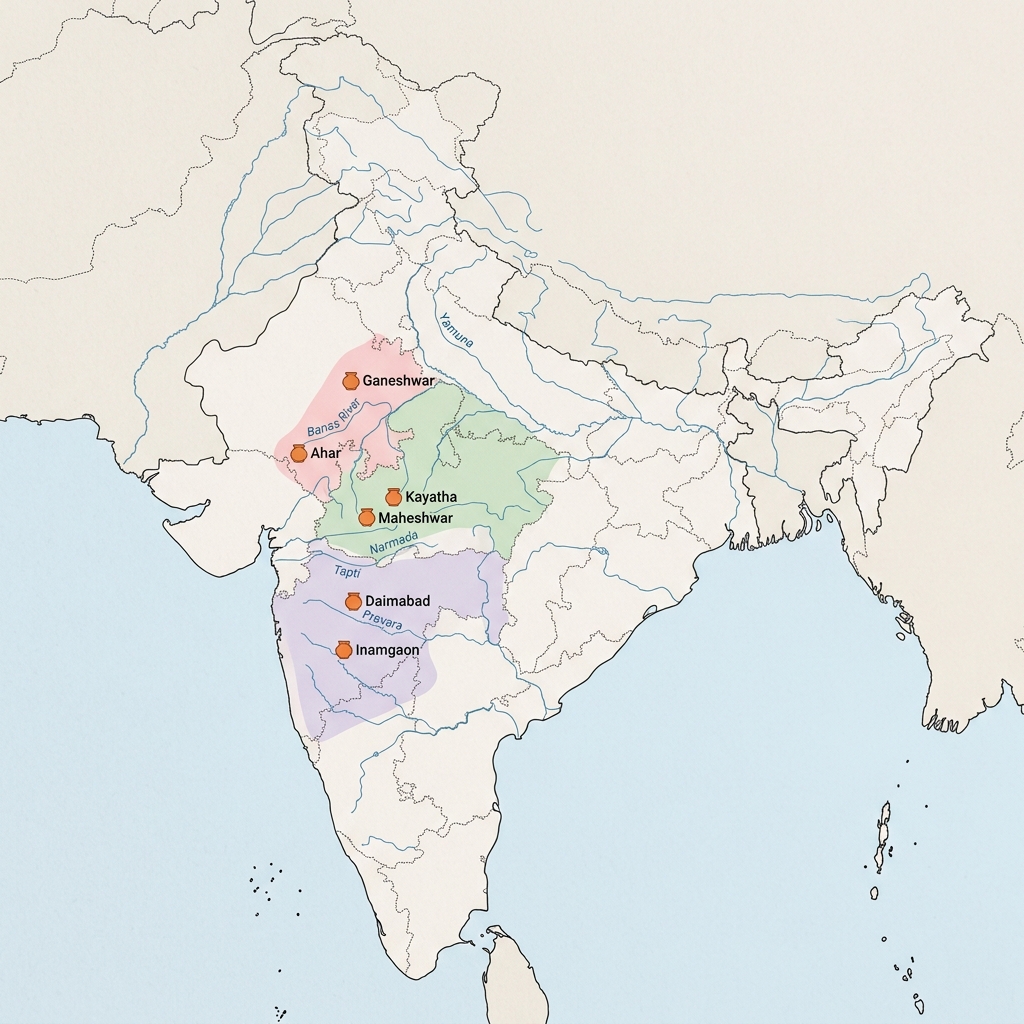
Daimabad (Maharashtra)
The largest Chalcolithic site discovered — associated with the Jorwe Culture.Ganeshwar (Rajasthan, near Banas Valley)
Extremely rich in copper tools.Sanganakallu (Karnataka)
Ash mounds at this Neolithic–Chalcolithic transition site.Regional Chalcolithic Cultures & Timelines
| Culture | Period (B.C.) | Region / Features |
|---|---|---|
| Kayatha Culture | 2000–1800 | Western MP (Kalisindh River) |
| Ahar / Banas Culture | 2000–1400 | SE Rajasthan (Ahar, Banas, Gilund) |
| Savalda Culture | 2000–1800 | Maharashtra (Tapti River) |
| Malwa Culture | 1700–1200 | Western MP (Narmada River) |
| Prabhas Culture | 1800–1500 | Gujarat coastal site |
| Jorwe Culture | 1400–700 | W. Maharashtra (Daimabad, Nevasa, Inamgaon) |
| Rangpur Culture | 1400–700 | Gujarat |
| Chirand Culture | 1500–750 | Bihar (Ganga Basin) |
06
Quick Revision Table
| Fact / Topic / Site | Key Detail |
|---|---|
| Father of Indian Archaeology | Alexander Cunningham (First DG of ASI) |
| First Palaeolithic Tool in India | Robert Bruce Foote, Pallavaram (Chennai) |
| India's Oldest Rock Paintings | Bhimbetka Caves, MP (V.S. Wakankar, 1957) |
| First Discovery of Rock Art | Archibald Carlleyle, Sohagighat, UP |
| Earliest Animal Domestication | Bagor (Rajasthan) & Adamgarh (MP) |
| Earliest Agriculture (Subcontinent) | Lahuradeva, UP (Rice: 9,000–7,000 B.C.) |
| Earliest Pottery in the World | Chopani Mando, UP |
| First Cereal Used by Humans | Barley (~8,000 B.C.) |
| Pit Dwellings & Dog Burials | Burzahom, Kashmir |
| Three Skeletons in One Grave | Damdama, UP |
| Four Skeletons in One Grave | Sarai Nahar Rai, UP |
| First Metal Used by Man | Copper (Chalcolithic Phase) |
| Largest Chalcolithic Site | Daimabad, Maharashtra (Jorwe Culture) |
| Jadeite Stone Neolithic Site | Daojali Hading, Assam |
07
Rapid Fire Practice Check
Q1. Who is universally known as the "Father of Indian Archaeology"?
- A. Robert Bruce Foote
- B. Alexander Cunningham
- C. V.S. Wakankar
- D. Sir John Lubbock
B — Alexander Cunningham
Q2. The earliest evidence of pottery use in the world was recovered from which site?
- A. Mehrgarh
- B. Chopani Mando
- C. Koldihwa
- D. Burzahom
B — Chopani Mando
Q3. Where was the unique evidence of burying domestic dogs with their masters discovered?
- A. Gufkral
- B. Chirand
- C. Burzahom
- D. Paiyampalli
C — Burzahom
Q4. Who discovered the world-famous Bhimbetka rock caves in 1957?
- A. Archibald Carlleyle
- B. Alexander Cunningham
- C. V.S. Wakankar
- D. Dr. Jai Narayan Pandey
C — V.S. Wakankar
Q5. The earliest evidence of agriculture in the Indian subcontinent is found at:
- A. Mehrgarh
- B. Lahuradeva
- C. Chopani Mando
- D. Koldihwa
B — Lahuradeva
Q6. Three human skeletons in a single grave were recovered from:
- A. Sarai Nahar Rai
- B. Damdama
- C. Mahadaha
- D. Langhnaj
B — Damdama
Q7. Which was the very first metal discovered and used by humans?
- A. Iron
- B. Bronze
- C. Copper
- D. Gold
C — Copper
Q8. The Chalcolithic people were completely unacquainted with which animal and building material?
- A. Cattle and Mud houses
- B. Sheep and Straw roofs
- C. Horses and Burnt bricks
- D. Dogs and Stone walls
C — Horses and Burnt bricks
Q9. From which Neolithic site have ash mounds been recovered?
- A. Sangana Kallu
- B. Hallur
- C. Maski
- D. Daojali Hading
A — Sangana Kallu
Q10. Ostrich eggshells were first discovered in India at which Palaeolithic site?
- A. Attirampakkam
- B. Hunasagi
- C. Didwana
- D. Patne
D — Patne
Q11. Who authored 'History of British India' and divided Indian History into Hindu, Muslim, and British phases?
- A. C.J. Thomson
- B. Archibald Carlleyle
- C. James Mill
- D. Sir John Lubbock
C — James Mill
Q12. What was the chronological evolutionary sequence of early humans?
- A. Australopithecus → Erectus → Habilis → Neanderthalensis → Sapiens
- B. Australopithecus → Habilis → Erectus → Neanderthalensis → Sapiens
- C. Erectus → Australopithecus → Habilis → Neanderthalensis → Sapiens
- D. Australopithecus → Neanderthalensis → Habilis → Erectus → Sapiens
B — Australopithecus → Habilis → Erectus → Neanderthalensis → Sapiens