Chapter 1: Origin of Heterodox Sects & Socio-Economic Factors
- Socio-Economic Upheaval: The 6th century BC saw the rise of territorial states (Mahajanapadas), second urbanisation, expansion of trade, and the introduction of punch-marked coins.
- Varna Rigidity: The birth-based rigidity of the Vedic Varna system and Brahmanical dominance over rituals led to reaction from the Kshatriyas (both Buddha and Mahavira belonged to Kshatriya clans).
- Intellectual Revolution: A total of 62 heterodox sects (non-conformists who rejected Vedic authority) emerged in this period, with Buddhism and Jainism being the most prominent.
Both Buddhism and Jainism are heterodox (Nastika) systems because they rejected the absolute authority of the Vedas, opposed animal sacrifices, and dismissed birth-based social stratification.
Chapter 2: Buddhism — Gautama Buddha, Doctrines, Councils & Sects
A. Gautama Buddha's Life
- Birth: Born in 563 BC on Vaisakh Purnima day at Lumbini in Kapilvastu (present-day Nepal). Birth confirmed by Emperor Ashoka's Rummindei/Rumini Dei Pillar Inscription.
- Lineage: Sakya Clan of Kshatriyas. Father: Suddhodana (ruler of Kapilvastu). Mother: Mahamaya (died on 7th day of birth). Raised by Foster Mother: Mahaprajapati Gautami.
- Great Renunciation (Mahabhinishkramana): At age 29, after seeing four sights: an Old man, a Sick man, a Corpse, and an Ascetic.
- Teachers: Alara Kalama (at Rajgriha; taught Samkhya philosophy and attainment of Shunya/Nothingness); Udraka Ramaputra (at Rajgriha; taught yoga).
- Enlightenment (Nirvana): At age 35, after 6 years of intense penance at Uruvela (Bodh Gaya, Bihar) on the bank of River Niranjana (Falgu) under a Pipal (Bodhi) Tree. Sujata offered him milk-rice.
- First Sermon (Dharmachakraparivartana): Given at Sarnath (Rishipattana, Varanasi) to five disciples: Asvajit, Upali, Mogallana, Sariputra, and Ananda.
- Death (Mahaparinirvana): 483 BC (aged 80) at Kushinagar (village Kasia, Deoria, UP) after eating food offered by Chunda (blacksmith). Relics divided into 8 parts; stupas built over them.
- Maximum Sermons: Preached at Sravasti (Capital of Kosala kingdom).
Gautama Buddha did not write any texts. His teachings were compiled orally after his death at the First Buddhist Council.
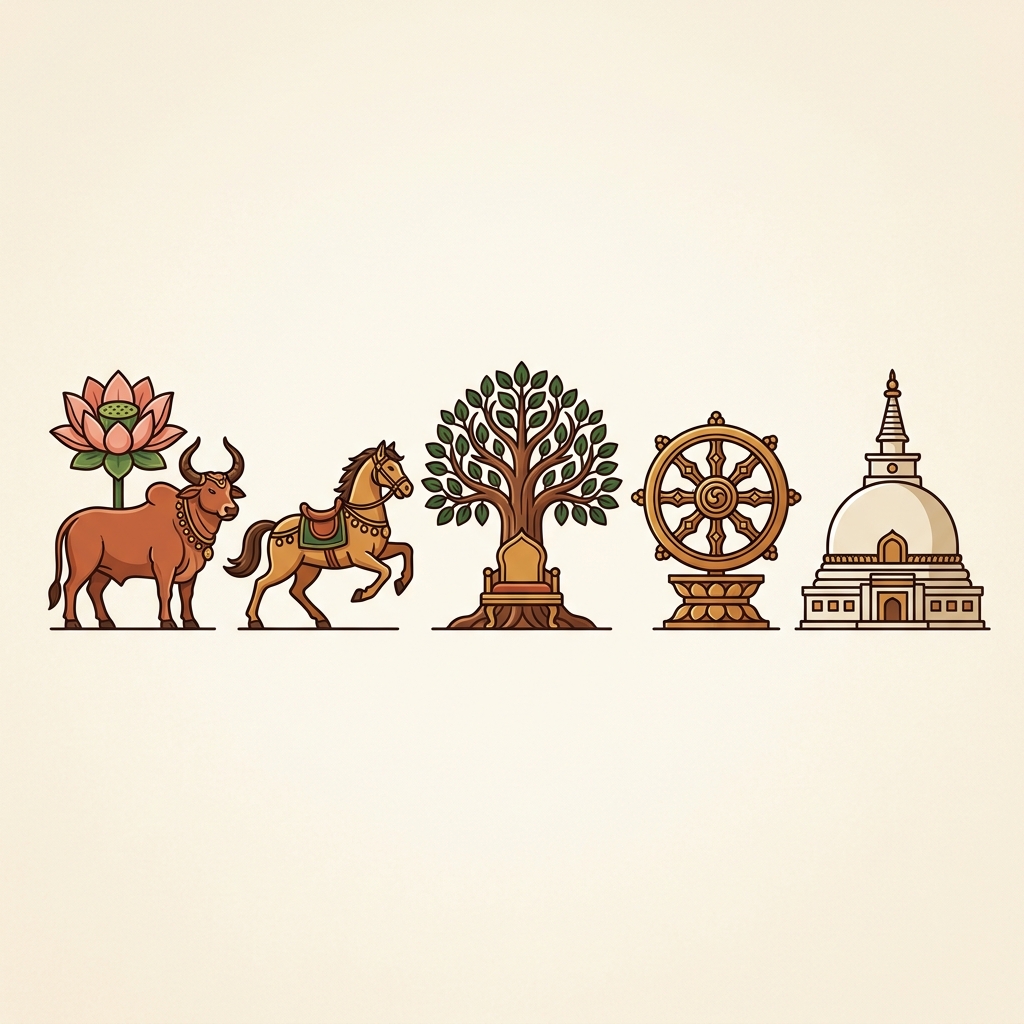
| Event of Buddha's Life | Pali/Sanskrit Name | Symbol |
|---|---|---|
| Birth | Janma | Lotus & Bull |
| Great Renunciation | Mahabhinishkramana | Horse (Kanthaka) |
| Enlightenment | Nirvana | Bodhi Tree (Pipal) / Footprints |
| First Sermon | Dharmachakraparivartana | Wheel (Dharmachakra) |
| Death | Mahaparinirvana | Stupa |
Remember the acronym B-L-R-H-E-B-S-W-D-S (Birth-Lotus, Renunciation-Horse, Enlightenment-Bodhi, Sermon-Wheel, Death-Stupa) to easily match events and symbols in matchmaking exam questions.
B. Doctrines & Philosophy
- Four Noble Truths (Arya Satyas):
- Dukkha: The world is full of sorrow.
- Samudaya: Desire (Tanha) is the root cause of sorrow.
- Nirodha: If desire is conquered, sorrow can be eliminated.
- Magga: Desire can be removed by following the Eightfold Path.
- Ashtangika Marga (Eightfold Path): Categorised into Pragya (Wisdom), Shila (Conduct), and Samadhi (Meditation).
- Right View (Samma-ditthi)
- Right Intention (Samma-sankappa)
- Right Speech (Samma-vaca)
- Right Action (Samma-kammanta)
- Right Livelihood (Samma-ajiva)
- Right Effort (Samma-vayama)
- Right Mindfulness (Samma-sati)
- Right Concentration (Samma-samadhi)
- Three Jewels (Triratna): Buddha (Founder), Dhamma (Teachings), Sangha (Monastic Order).
- Middle Path (Madhyamika Marga): Avoids extreme luxury and extreme penance.
- Rebirth and Karma: Believed in rebirth based on Karma, but rejected the concept of an eternal soul (Anatman / Anatta).
Buddhism is an atheistic system. It did not recognize a creator God or permanent soul (atman) but firmly believed in rebirth (reincarnation).
C. Buddhist Councils & Sects
Buddhist Councils:
* First Council (483 BC): At Saptaparni cave near Rajagriha. Patron: Ajatashatru (Haryanka dynasty). Chairman: Mahakassapa. Compiled Sutta Pitaka (by Ananda) and Vinaya Pitaka (by Upali).
* Second Council (383 BC): At Vaishali. Patron: Kalashoka (Shisunaga dynasty). Chairman: Sabakami. Split into Sthaviravadins (orthodox) and Mahasanghikas (liberal).
* Third Council (250 BC): At Pataliputra. Patron: Ashoka (Maurya dynasty). Chairman: Moggaliputta Tissa. Compilation of Abhidhamma Pitaka; added Kathavatthu.
* Fourth Council (72 AD / 1st Century AD): At Kundalvana (Kashmir). Patron: Kanishka (Kushan dynasty). Chairman: Vasumitra (Deputy: Asvaghosha). Formal split of Buddhists into Hinayana and Mahayana.
Major Sects:
* Hinayana (Theravada): Believed in original teachings of Buddha, individual salvation through self-discipline, no idol worship, used Pali language.
* Mahayana: Believed in divinity of Buddha, salvation for all through grace of Buddha and Bodhisattvas, idol worship, used Sanskrit language.
* Vajrayana: Tantric Buddhism, believed in magical powers (Vajra) and Taras (female divinities); popular in Eastern India (Bengal and Bihar under Palas).
While Hinayana is popular in Sri Lanka, Myanmar, Thailand, Cambodia, and Laos (Southern Buddhism), Mahayana is dominant in China, Japan, Korea, and Tibet (Northern Buddhism). Vajrayana is prevalent in Tibet, Mongolia, and Bhutan.
Chapter 3: Buddhist Literature, Architecture & Universities
A. Buddhist Literature
- Tripitaka (Three-fold Basket in Pali):
- Vinaya Pitaka: Rules of monastic discipline. Subdivided into Suttavibhanga, Khandakas, and Parivarpatha.
- Sutta Pitaka: Buddha's teachings and sermons. Divided into 5 Nikayas:
- Digha Nikaya (profound philosophical dialogues)
- Majjhima Nikaya (middle-length discourses)
- Samyutta Nikaya (connected discourses)
- Anguttara Nikaya (numerical arrangement; lists the 16 Mahajanapadas)
- Khuddaka Nikaya (miscellaneous; includes Jataka Tales detailing previous births of Buddha, and Therigatha - poems by senior nuns called Theris)
- Abhidhamma Pitaka: Deep philosophical analysis of teachings in a Q&A format. Contains 7 books; most important is Kathavatthu attributed to Moggaliputta Tissa.
- Non-Canonical Literature:
- Milindapanho: Dialogue between Indo-Greek King Menander I (Milinda) and monk Nagasena.
- Buddhacharita: Sanskrit epic biography of Buddha by Asvaghosha.
- Dipavamsa & Mahavamsa: Sri Lankan chronicles describing the expansion of Buddhism.
B. Architecture & Bodhisattvas
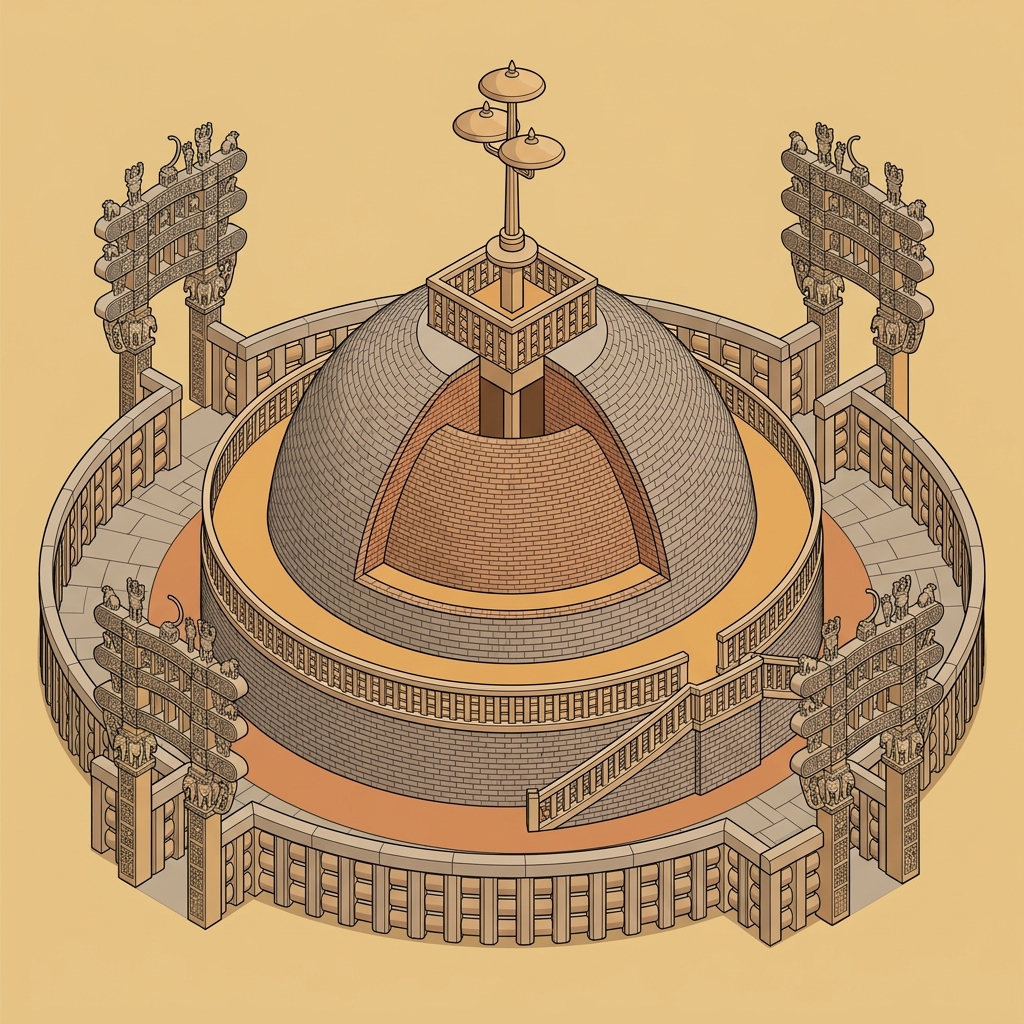
- Stupa Elements:
- Anda: Hemispherical dome representing the universe.
- Harmika: Railed balcony atop the Anda containing sacred relics of Buddha/monks.
- Chattra: Umbrella on top representing the three jewels (Buddha, Dhamma, Sangha).
- Torana: Highly ornamented arched gateways representing cardinal directions.
- Pradakshina Patha: Elevated path for circumambulation.
- Key Stupas:
- Sanchi Stupa (MP): Oldest stone stupa, originally built by Ashoka, expanded by Shungas.
- Kesariya Stupa (Bihar): Tallest stupa in the world, built by Ashoka.
- Dhamek Stupa (Sarnath): Marks the spot of the first sermon.
- Piprahwa Stupa (UP): Oldest surviving stupa, built by the Sakya clan.
- Bodhisattvas (Mahayana Ideals):
- Padmapani (Avalokitesvara): Holds lotus; symbol of infinite compassion.
- Vajrapani: Holds thunderbolt; protector and guide.
- Manjushri: Holds book describing 10 paramitas; symbol of wisdom.
- Maitreya: The Future Buddha.
- Amitabha: Buddha of infinite light.
C. Major Buddhist Universities
| University | Location | Founder | Royal Dynasty |
|---|---|---|---|
| Nalanda | Badagaon, Bihar | Kumaragupta-I | Gupta Empire |
| Vikramshila | Bhagalpur, Bihar | Dharmapala | Pala Dynasty |
| Somapuri | North Bengal | Dharmapala | Pala Dynasty |
| Odantpuri | Bihar Sharif, Bihar | Gopala | Pala Dynasty |
| Jagadal | North Bengal | Ramapala | Pala Dynasty |
| Vallabhi | Gujarat | Bhattarka | Maitraka Dynasty |
Chapter 4: Jainism — Tirthankaras, Vardhamana Mahavira, Doctrines & Councils
A. The Tirthankaras
- Concept: Tirthankaras are "ford-makers" who help cross the ocean of life. There are exactly 24 Tirthankaras.
- 1st Tirthankara: Rishabhdev (Adinath) — Born in Ayodhya; symbol is Bull. Mentioned in Rigveda along with Aristanemi (22nd). Vishnu and Bhagavata Puranas describe him as an incarnation of Narayana.
- 23rd Tirthankara: Parsavanath — Son of King Ashvasena of Kashi; symbol is Serpent. Attained Kaivalya on Sammed Shikhar. He gave 4 teachings (Chaturyama Dharma): Ahimsa, Satya, Asteya, Aparigraha.
- 24th Tirthankara: Vardhamana Mahavira — Symbol is Lion.
B. Vardhamana Mahavira's Life
- Birth: Born in 540 BC at Kundagram near Vaishali (Bihar).
- Lineage: Jnatrika Kshatriya clan. Father: Siddhartha. Mother: Trishala (sister of Lichchhavi Prince Chetaka).
- Marriage: Yashoda. Daughter: Priyadarshana (Anojja). Son-in-law & First disciple: Jamali.
- Renunciation: Left home at age 30 (with permission of elder brother Nandivardhan). Wandered for 12 years. Met Makkhali Gosala (founder of Ajivika sect) during wanderings.
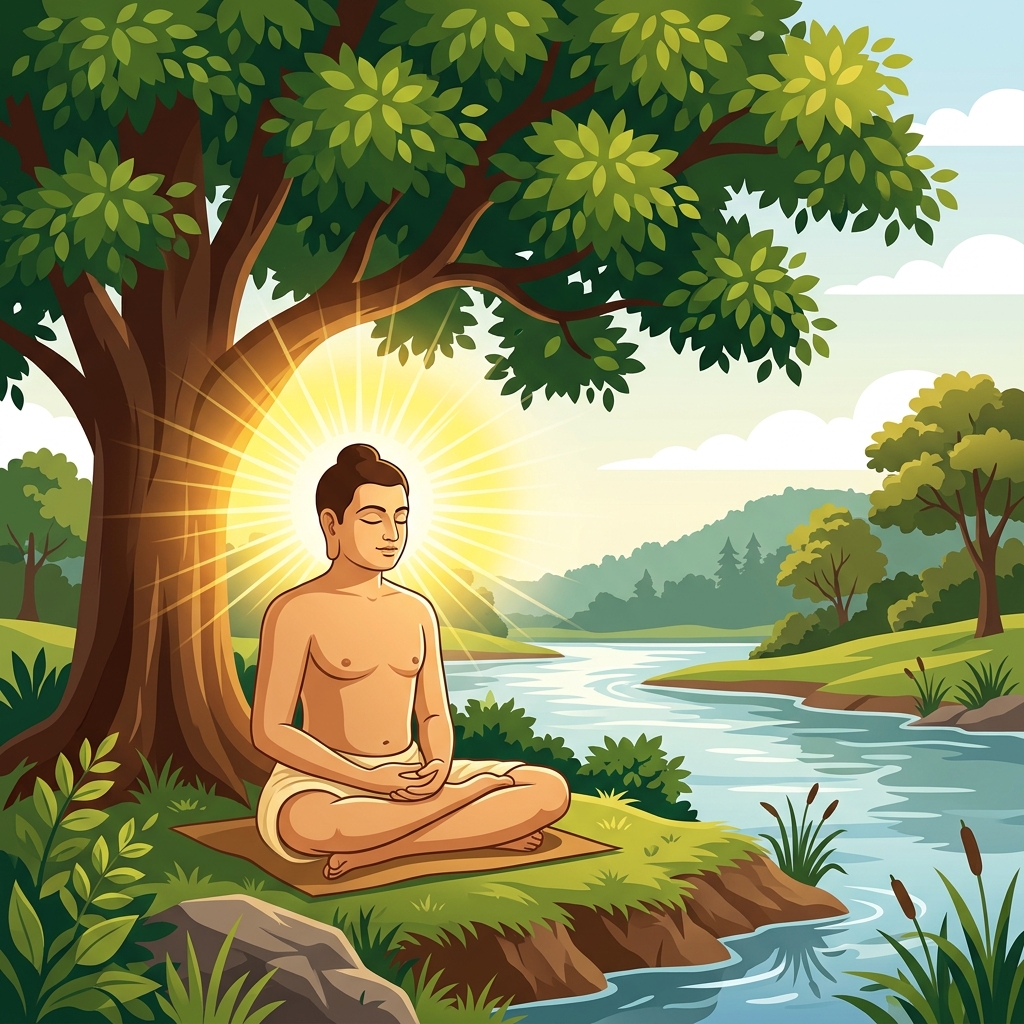
- Kaivalya (Enlightenment): At age 42, under a Sal Tree near Jrimbhikgrama on the bank of River Rijupalika. Obtained titles: Jina (Conqueror), Arhat (Worthy), Nirgrantha (Free from bonds), Kevalin (Perfect learner).
- First Sermon: Delivered at Pava (in Prakrit language).
- Death (Nirvana): 468 BC (aged 72) at Pavapuri (near Rajgir) through Sallekhana (ritual fasting) in the palace of Malla king Sastipal.
Unlike Buddha, who advocated a Middle Path (Madhyamika), Mahavira advocated extreme asceticism and penance (Sallekhana) for liberation.
C. Doctrines, Philosophy & Councils
- Three Jewels (Triratna):
- Samyak Darshana (Right Faith)
- Samyak Jnana (Right Knowledge)
- Samyak Charitra (Right Conduct)
- Five Vows (Panch Mahavratas):
- Ahimsa (Non-injury) — Over-emphasised (agriculture prohibited to protect microbes).
- Satya (Truthfulness)
- Asteya (Non-stealing)
- Aparigraha (Non-possession / detachment)
- Brahmacharya (Chastity) — Added exclusively by Mahavira.
- Syaadvaada / Anekantavada: The theory of "May-be" or pluralism of truth (seven-fold prediction).
- Cosmology: Believes the universe is eternal and composed of 6 substances (Jiva, Pudgala, Dharma, Adharma, Akasha, Kala). Denies creator God. Believes every object (living and non-living) has a soul (Jiva).
Jain Councils:
* First Council (300 BC): At Pataliputra. Patron: Chandragupta Maurya. Chairman: Sthulabhadra. Compiled 12 Angas (replacing lost 14 Purvas). Bhadrabahu boycotted.
* Second Council (513 AD / 6th Century AD): At Valabhi (Gujarat). Chairman: Devardhi Kshamasramana. Final compilation of 12 Angas and 12 Upangas.
Chapter 5: Jain Sects, Literature, Royal Patrons & Architecture
A. Sect Split: Digambara vs. Shvetambara
Around 300 BC, a severe 12-year famine in Magadha led to a migration of Jain monks:
* Digambara (Sky-clad): Migrated to South India (Shravanabelagola, Karnataka) under the leadership of Bhadrabahu. Adhered to strict nudity and extreme asceticism. Believe women cannot attain liberation directly in this birth.
* Shvetambara (White-clad): Remained in Magadha under the leadership of Sthulabhadra. Allowed wearing white garments. Believe women can attain liberation (e.g., Mallinath, 19th Tirthankara, believed to be female by Shvetambaras).
B. Jain Literature (Agam Literature)
Written in Prakrit (specifically Ardhamagadhi language). Includes:
* 12 Angas (Core doctrines)
* 12 Upangas (Supplementary texts)
* 10 Prakirnas (Miscellaneous texts)
* 6 Chhedsutras (Monastic rules)
* 4 Mulasutras (Foundational texts)
* Bhagavati Sutra: Mentions the list of 16 Mahajanapadas (similar to Buddhist Anguttara Nikaya).
* Kalpasutra: Biography of Tirthankaras written by Bhadrabahu in Sanskrit.
* Acharangasutra: Code of conduct and rules for Jain monks.
C. Royal Patrons & Art of Jainism
- Patrons: Chandragupta Maurya (migrated with Bhadrabahu and performed Sallekhana at Shravanabelagola), Samparati (grandson of Ashoka), King Kharavela of Kalinga, Rashtrakuta King Amoghavarsha, Chandela Rulers.
- Jain Art and Architecture:
- Mathura School of Art: Centre of Jain art in post-Mauryan era.
- Dilwara Temples (Mount Abu, Rajasthan): Famous marble temples built by Solanki rulers.
- Gomteshwara/Bahubali Statue (Shravanabelagola, Karnataka): 57-ft monolithic statue built by Chamundaraya (Ganga dynasty minister). Mahamastakabhisheka festival held here once every 12 years.
- Udayagiri and Khandagiri Caves (Odisha): Rock-cut caves, patronage of King Kharavela (contains Hathigumpha inscription).
Chapter 6: Direct Comparison — Buddhism vs. Jainism
| Feature | Buddhism | Jainism |
|---|---|---|
| Concept of Soul | Anatman (Does not believe in soul) | Jiva (Believes every object has a soul) |
| Path to Salvation | Middle Path (Madhyamika Marga) | Extreme Penance / Asceticism (Sallekhana) |
| Ahimsa Policy | Liberal (permits eating meat if not killed for them) | Extreme (prohibits agriculture to protect microbes) |
| Primary Language | Pali | Prakrit (Ardhamagadhi) |
| Geographic Spread | Declined in India but spread worldwide (due to Ashoka) | Confined mostly to India, survived continuously |
| Creator God | Silent / Atheistic | Rejects Creator God; Tirthankaras are supreme |
Chapter 7: Quick Revision Table
| Parameter | Buddhism | Jainism |
|---|---|---|
| Founder | Gautama Buddha | Rishabhdev (1st Tirthankara) |
| Key Propagator | Gautama Buddha | Vardhamana Mahavira (24th) |
| Birth Date/Place | 563 BC, Lumbini (Nepal) | 540 BC, Kundagram (Vaishali) |
| Death Date/Place | 483 BC, Kushinagar (UP) | 468 BC, Pavapuri (Bihar) |
| Enlightenment Place | Bodh Gaya (Niranjana river, Pipal tree) | Jrimbhikgrama (Rijupalika river, Sal tree) |
| First Sermon Place | Sarnath (Varanasi) | Pava (near Rajgir) |
| First Council | 483 BC, Rajagriha (Patron: Ajatashatru) | 300 BC, Pataliputra (Patron: Chandragupta Maurya) |
| Key Literature | Tripitakas (Sutta, Vinaya, Abhidhamma) | Agamas (12 Angas, 12 Upangas) |
| Key Symbols | Lotus, Bull, Horse, Bodhi Tree, Stupa | Bull (Rishabh), Serpent (Parsva), Lion (Mahavira) |
Chapter 8: High-Yield Practice MCQs
Q1Which of the following Buddhist texts lists the sixteen Mahajanapadas of Ancient India?
(A) Digha Nikaya (B) Anguttara Nikaya (C) Majjhima Nikaya (D) Khuddaka Nikaya
Show answer
Answer: (B) Anguttara Nikaya
Q2Vardhamana Mahavira attained Kaivalya under which of the following trees?
(A) Pipal Tree (B) Banyan Tree (C) Sal Tree (D) Neem Tree
Show answer
Answer: (C) Sal Tree
Q3The division of Jainism into Digambaras and Shvetambaras occurred due to a famine during the reign of which king?
(A) Ashoka (B) Chandragupta Maurya (C) Bimbisara (D) Kanishka
Show answer
Answer: (B) Chandragupta Maurya
Q4Who among the following was the president of the Third Buddhist Council held at Pataliputra?
(A) Mahakassapa (B) Sabakami (C) Vasumitra (D) Moggaliputta Tissa
Show answer
Answer: (D) Moggaliputta Tissa
Q5Which of the following monuments is famous for the 57-feet monolithic statue of Gomteshwara and host of the Mahamastakabhisheka festival?
(A) Dilwara (B) Mount Abu (C) Shravanabelagola (D) Udayagiri
Show answer
Answer: (C) Shravanabelagola
Q6Who was the first female disciple admitted into the Buddhist Sangha on the recommendation of Ananda?
(A) Yasodhara (B) Mahaprajapati Gautami (C) Sujata (D) Trishala
Show answer
Answer: (B) Mahaprajapati Gautami
Q7In Buddhist architecture, what is the railed balcony-like structure atop the Anda that holds the sacred relics called?
(A) Chattra (B) Torana (C) Medhi (D) Harmika
Show answer
Answer: (D) Harmika
Q8Which Jain Tirthankara's biography and other Tirthankaras are detailed in the text "Kalpasutra" written by Bhadrabahu?
(A) Rishabhdev (B) Parsavanath (C) Vardhamana Mahavira (D) Aristanemi
Show answer
Answer: (C) Vardhamana Mahavira
Q9Which Pala ruler founded the famous Vikramshila University in Bihar?
(A) Gopala (B) Dharmapala (C) Devapala (D) Ramapala
Show answer
Answer: (B) Dharmapala
Q10The dialect / language used for the compilation of the early Jain Agam literature was:
(A) Pali (B) Sanskrit (C) Ardhamagadhi Prakrit (D) Sauraseni
Show answer
Answer: (C) Ardhamagadhi Prakrit