Index
01
Native Dynasties
The decline of the Mauryan Empire in 187 BCE led to political fragmentation, giving rise to several indigenous powers in northern, central, and southern India.
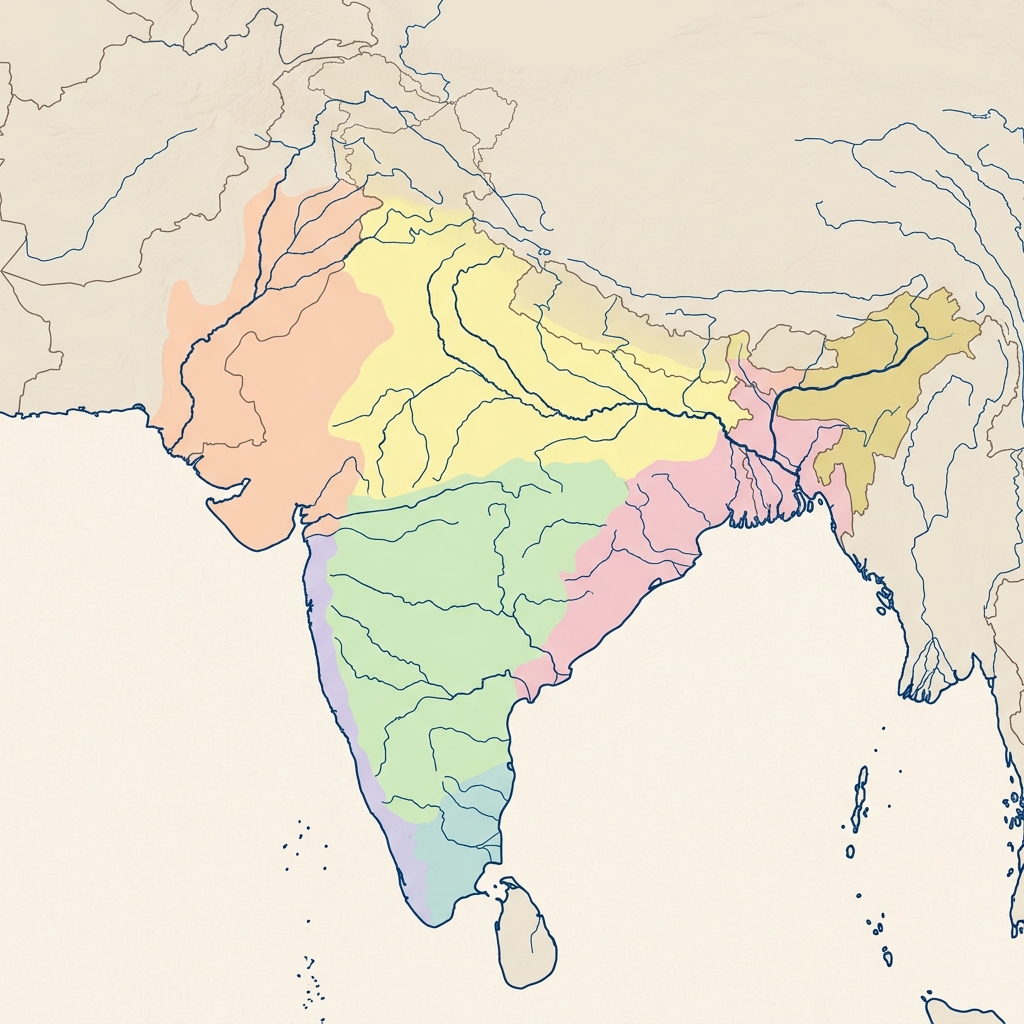
Insert image — Map of Post‑Mauryan Dynasties
Shunga Dynasty
- Founder & Origin: Established by Pushyamitra Shunga, the Brahman commander-in-chief (Senapati) of the Maurya army, who assassinated the last Mauryan ruler, Brihadratha, during a military parade in 185 BCE.
- Capital: Shifted from Pataliputra to Vidisha (Madhya Pradesh).
- Territorial Extent: Northwestern and central India, up to the Narmada River in the south.
- Religious Character: Strongly revived Vedic Brahmanism and Brahmanical culture.
- Performed two Ashvamedha Yagnas (horse sacrifices), recorded in Dhanadeva's Ayodhya Inscription.
- Patanjali — father of Sanskrit grammar — was his high priest and authored the Mahabhashya.
- Key Conflicts: Defeated Indo-Greek invaders Demetrius and Menander; fought Kalinga King Kharavela and expanded into Vidarbha.
- Art & Literature: Despite Buddhist text Divyavadana calling him a destroyer of monasteries, he renovated and expanded the stupas at Sanchi and Bharhut with stone gateways.
- Agnimitra (149–141 BCE): Pushyamitra's son, hero of Kalidasa's play Malavikagnimitram.
- Decline: Last ruler Devabhuti (83–73 BCE) was assassinated by his Brahman minister Vasudeva Kanva.
Important
Pushyamitra Shunga was a Brahmin military commander who founded the first orthodox Brahminical dynasty after defeating the Buddhist Mauryas, reviving Ashvamedha sacrifices after centuries.
Exception
Although Divyavadana claims Pushyamitra destroyed monasteries, archaeology shows Sanchi and Bharhut Stupas were extensively expanded with decorative stone gateways during his reign.
Kanva Dynasty
- Founder: Vasudeva Kanva, after assassinating last Shunga king Devabhuti.
- Classification: Also known as "Shungabhrityas" ("Servants of the Shungas").
- Capital: Pataliputra.
- Decline: Last ruler Susharman was assassinated by Simuka, paving the way for the Satavahana Empire.
Vasudeva Kanva 73–64 BCE→
Bhumimitra 64–50 BCE→
Narayana→
Susharman 38–28 BCE
Satavahana Dynasty
- Identity & Region: Also known as Andhras/Andhrabhrityas. Ruled the Deccan — modern Maharashtra, Andhra Pradesh, Telangana, Karnataka & parts of Gujarat.
- Founder: Simuka (Sindhuka / Shiprak).
- Capitals: Paithan (Pratisthan) on the Godavari; earlier capital believed to be Amravati.
- Official Language: Prakrit. King Hala composed Gathasaptasati.
- Naming vs. Succession: Matrilineal naming (Gautamiputra Satakarni, Vashishtiputra Pulumavi) but strictly patrilineal succession (only sons became kings).
- Land Grants: First dynasty to donate tax-free land grants (Agrahara) to Brahmins and Buddhist monks.
- Coinage: Lead (imported from Rome), potin, copper, bronze, silver — with Prakrit inscriptions.
- Satakarni I: First to assume the title 'Satakarni'; his two Ashvamedha & one Rajasuya Yagna recorded in the Naneghat Inscription of Queen Nayanika.
- Gautamiputra Satakarni (106–130 CE): Greatest Satavahana ruler (21st king). Destroyed the Saka Kshaharata dynasty by defeating Nahapana; took the title "Eka Brahmana" (Nasik Inscription, by mother Gautami Balashri); strictly enforced Varna system.
- Vashishtiputra Pulumavi (130–154 CE): Married daughter of Saka King Rudradaman I (Kanheri Inscription) yet was defeated by him twice; shifted capital to Pratisthana, expanded Rome trade.
- Yajnasri Satakarni (165–194 CE): Last great king — coins depict ships, showing maritime trade.
- Local Administration: Rural units run by Golmikas — commanders of 9 chariots, 9 elephants, 25 horses, 45 foot soldiers.
Important
The Satavahanas pioneered land-grant administration (tax-free land to priests/monks), laying the foundation for Indian feudalism.
Exception
Despite using mother's names, the royal family was strictly patrilineal — the queen mother was respected, but only male heirs succeeded.
Chedi Dynasty of Kalinga
- Origin: Emerged in Kalinga (modern Odisha) after Mauryan decline; also called the Mahameghavahana Dynasty ("Lord of the Great Cloud").
- Founder: Mahameghavarman.
- Kharavela — the greatest ruler (3rd of the dynasty): re-established Kalinga's military supremacy, took the title "Bhikshu Raja" (King Monk), a devout patron of Jainism; defeated the Satavahanas, Indo-Greeks and Magadhan rulers; excavated rock-cut caves on Udayagiri Hills (Rani Gumpha, Hathigumpha, Ganesh Gumpha).
- Hathigumpha Inscription: Primary, undated source on Kharavela's life — written in Prakrit and Brahmi script, records achievements up to his 38th year.
02
Foreign Invasions & Dynasties
After the Mauryan decline, northwest India faced successive foreign invasions from Central Asia — driven by the construction of the Great Wall of China (pushing nomadic tribes westward) and the weakening Seleucid Empire.
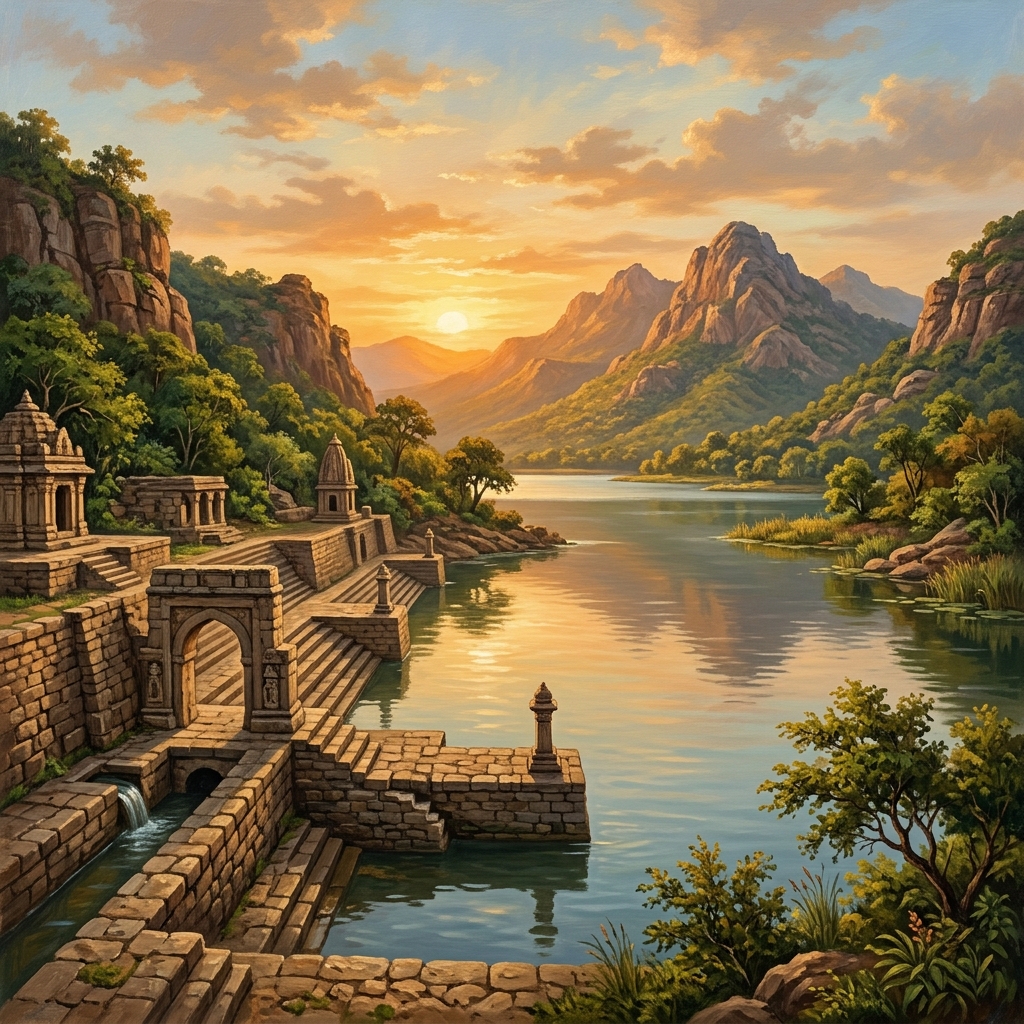
Insert image — Sudarshan Lake & Girnar Rock Inscription
💡
Chronology trick: I‑S‑P‑K (Indo-Greeks → Sakas → Parthians → Kushanas) — remember it as "I Shall Play Kabaddi."
Indo-Greek Kingdoms
- Origin: Hellenistic rulers from Bactria (north of Hindukush, modern Afghanistan/Iran border).
- First Invader: Demetrius I (Euthydemus dynasty), c. 190 BCE — captured Punjab & Gandhara, capital at Sakala (Sialkot); coins with elephant helmet & bilingual inscriptions.
- Menander I (Milinda) (165–145 BCE): Most famous Indo-Greek ruler. Converted to Buddhism after a debate with monk Nagasena — recorded in the Pali text Milindapanho ("Questions of Milinda").
- Coinage firsts: First to issue gold coins in India; first to put ruler portraits on coins; bilingual, biscriptal (Greek + Kharosthi Prakrit).
- Cultural Contributions: Hellenistic art inspired the Gandhara School; introduced the theatre curtain (Yavanika) and Horashastra (astrology, from Greek "horoscope").
Sakas (Scythians)
- Origin: Nomadic Central Asian tribes entering via the Bolan Pass, in search of pastures.
- Five Branches with capitals in Kabul, Punjab, Mathura, Western India, and Upper Deccan. First Saka king: Maues (Moga), in Gandhara.
- Vikram Samvat (57 BCE): Started by King Vikramaditya of Ujjain to mark his victory over the Sakas.
- Western Kshatrapas — Kshaharata Dynasty: Nahapana controlled Barygaza (Bharuch) & Ujjain, killed by Gautamiputra Satakarni.
- Western Kshatrapas — Kardamaka Dynasty: Founded by Chastana; famous ruler Rudradaman I (130–150 CE) repaired the Sudarshan Lake (Girnar, Gujarat) without forced labour (Vishti), and issued the Junagarh Rock Inscription — the earliest & longest flawless Sanskrit inscription in India (Brahmi script, "Kavya" style).
- Decline: Last Western Kshatrapa, Rudrasimha III, defeated and killed by Gupta Emperor Chandragupta II (Vikramaditya) in the early 5th century CE.
Important
The Junagarh Rock Inscription of Rudradaman I is the first long inscription in pure classical Sanskrit — showing even foreign rulers patronized Sanskrit over Prakrit.
Exception — Sudarshan Lake timeline
Pushyagupta (built)→
Tushaspha (canal)→
Rudradaman I (repaired)→
Skandagupta (restored)
Indo-Parthians / Pahlavas
- Origin: From Iran (ancient Persia), replaced the Sakas in northwest India. Founder: Mithridates I.
- Gondophares I (19–46 CE): Most famous Indo-Parthian king. Saint Thomas (Apostle of Jesus Christ) visited his court to propagate Christianity in India.
- Capital: Taxila (administrative centre) and Kabul.
Kushan Dynasty
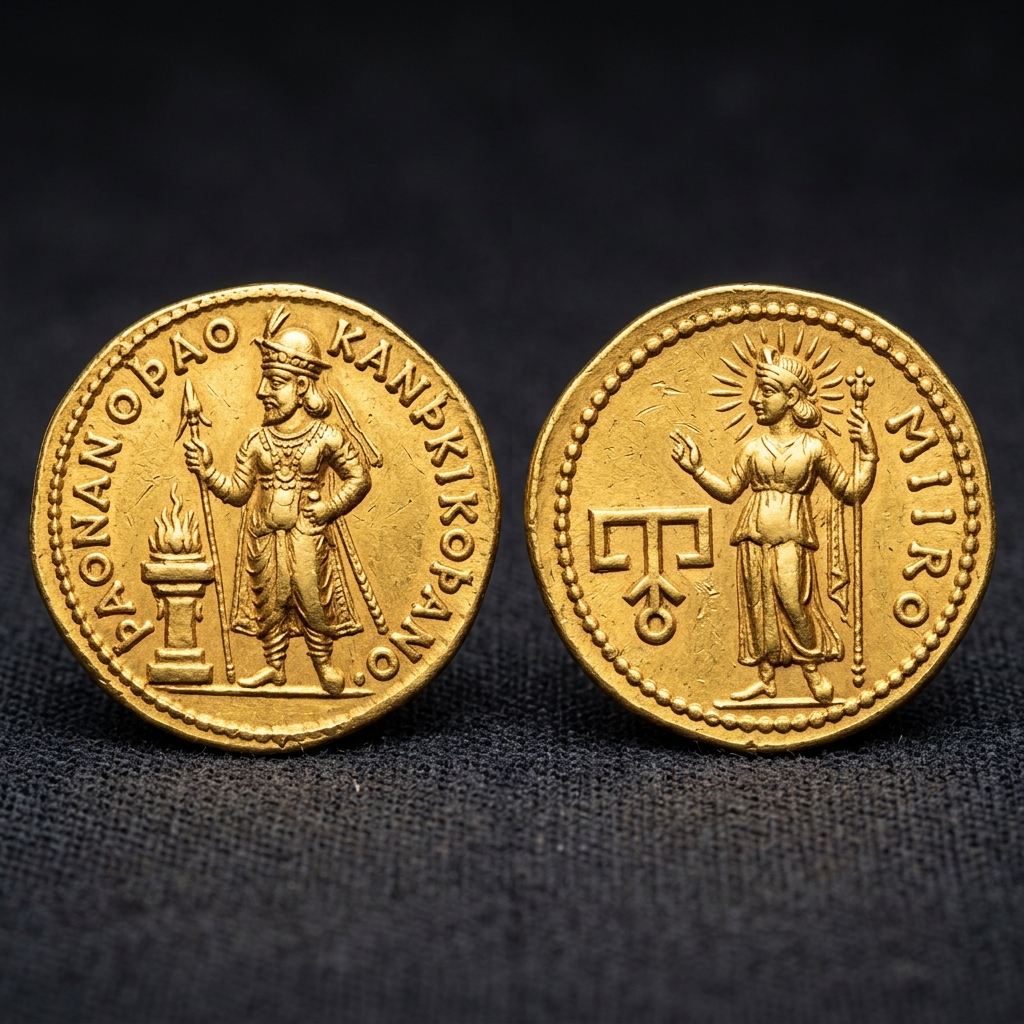
Insert image — Gold Coins of Kanishka & Kushan Art
- Origin: Part of the nomadic Yuezhi (Tocharian) tribe of Central Asia, displaced by the Xiongnu; unified five clans under the Kadphises dynasty.
Kujula Kadphises 30–80 CE→
Vima Taktu 80–95 CE→
Vima Kadphises 95–127 CE→
Kanishka I 127–150 CE→
Vasudeva I (last)
- Kujula Kadphises (30–80 CE): Founder — issued copper coins imitating Roman coins, titles Dharma-thida and Sach-dharma-thida.
- Vima Kadphises (95–127 CE): First to introduce gold coins for regular use in India; his lineage as Kanishka's father confirmed by the Rabatak Inscription.
- Kanishka I (127–150 CE, traditional 78 CE): The greatest Kushan king, the "Second Ashoka." Capitals: Purushpura (Peshawar), secondary Mathura.
- Shaka Era (78 CE) — later adopted by the Govt. of India (1957) as the National Calendar.
- Fourth Buddhist Council at Kundalvan (Kashmir), presided by Vasumitra — split Buddhism into Hinayana & Mahayana; Kanishka patronized Mahayana.
- First Indian rulers to fully control the Silk Road — traded silk, spices, textiles for Roman gold.
- Empire stretched from the Ganges to the Oxus (Amu Darya) River.
- Kanishka's court scholars: Charaka (physician, Charaka Samhita); Ashvaghosa (poet, Buddhacharita, Saundarananda); Nagarjuna ("Indian Einstein," Theory of Emptiness / Shunyata, Madhyamika Sutra); Vasumitra (presided 4th Council, compiled Mahavibhasha Sutra).
- Decline: Shift towards Shaivism — last great ruler Vasudeva I adopted a Hindu name, depicted Lord Shiva on coins.
03
Culture, Art & Administration
Gandhara vs. Mathura School of Art
The Kushan period witnessed a monumental flourish in Indian sculpture and art.
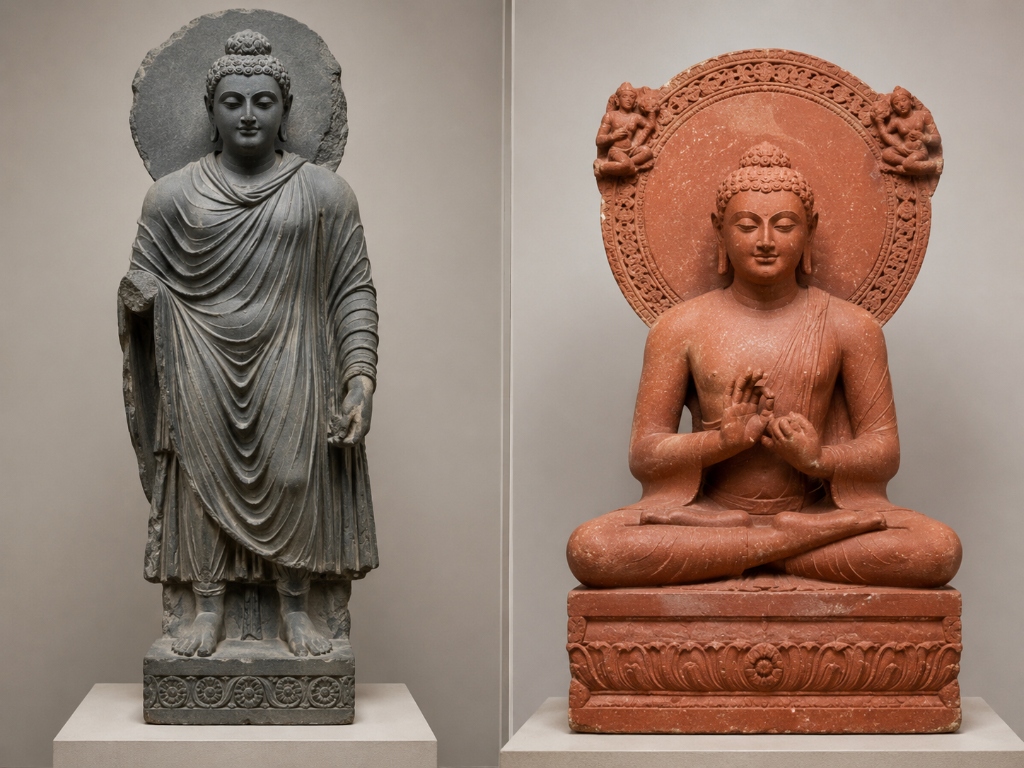
Insert image — Gandhara vs. Mathura School of Art
| Feature | Gandhara School | Mathura School |
|---|---|---|
| Origin & Influence | Foreign / Hellenistic (Greek & Roman) | Purely indigenous |
| Material | Grey / bluish schist sandstone | Spotted red sandstone |
| Religious Scope | Strictly Buddhist | Syncretic — Hindu, Buddhist, Jain |
| Halo Style | Plain, simple | Highly decorated |
| Buddha Features | Muscular, Greek curly hair, toga drapery | Spiritual, clean-shaven, smiling |
| Location | Taxila (Pakistan/Afghanistan) | Mathura (Uttar Pradesh) |
Administrative Innovations
- Satrap System: Provinces run by military governors — Mahakshatrapas (senior) and Kshatrapas (junior), from the Greek "Strategos".
- Devakula Concept: Mortuary temples worshipping statues of deceased kings, reinforcing divine kingship (Devaputra, "Son of God").
04
Quick Revision Table
| Ruler | Capital | Key Inscription/Text | Unique Exam Fact |
|---|---|---|---|
| Pushyamitra Shunga | Vidisha | Ayodhya Inscription (Dhanadeva) | Assassinated last Maurya; revived Ashvamedha |
| Agnimitra | Vidisha | Malavikagnimitram | Hero of India's first major romantic drama |
| Simuka | Paithan | Matsya Purana | Founded Satavahana dynasty after killing Susharman Kanva |
| Gautamiputra Satakarni | Paithan | Nasik Cave Inscription | Restored Satavahana glory; "Eka Brahmana"; defeated Nahapana |
| Kharavela | Kalinga | Hathigumpha Inscription | "Bhikshu Raja"; greatest Kalinga king; Jain patron |
| Menander I | Sialkot (Sakala) | Milindapanho | Indo-Greek king converted to Buddhism by Nagasena |
| Rudradaman I | Ujjain | Junagarh Rock Inscription | Repaired Sudarshan Lake; first long classical Sanskrit inscription |
| Gondophares I | Taxila | Bilingual coins | Apostle Saint Thomas visited during his reign |
| Kujula Kadphises | Peshawar | Copper imitation coins | Unified 5 Yuezhi clans; founded Kushan Empire |
| Vima Kadphises | Peshawar | Rabatak Inscription | Introduced gold coins for regular trade use |
| Kanishka I | Peshawar & Mathura | Sarnath Inscription | Started Shaka Era; organized 4th Buddhist Council |
05